MOT Status
MOT check
Enter a UK registration to see the full MOT history and current status, free and instant. Every test result, advisory, failure reason and mileage reading from the car third birthday onward, pulled directly from DVSA records.
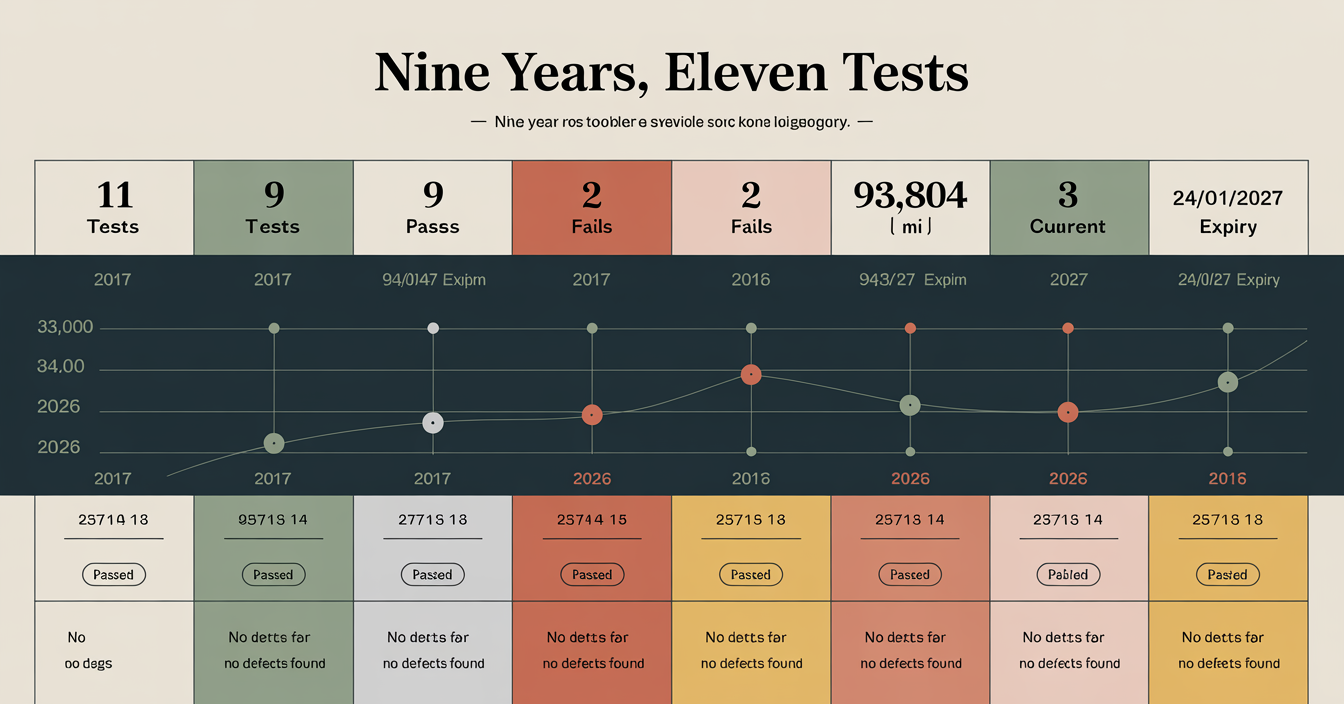
Current Status At a Glance
The check returns the current MOT status (valid or expired), the expiry date, and the date of the last test. If the MOT has expired, the car cannot legally be driven on a public road. Use this to confirm the basics before you go any further with a purchase.
Full Test History
Beyond the current status, the check shows every MOT test the car has been through. Each entry includes the result (pass or fail), the date, the recorded mileage, any advisory notes and any failure reasons. Read it as a maintenance timeline: a car with clean passes and steady mileage tells a different story from one with repeated brake failures and mileage gaps.
Mileage Built In
Every MOT records the mileage at the time of the test. The check shows these readings in order so you can see whether the mileage has risen steadily or whether there are drops and jumps that suggest clocking. For a dedicated analysis, run a mileage check which flags anomalies automatically.
Spotting patterns that matter
Repeated advisories on the same item (corrosion, brake wear, suspension) signal a problem the owner chose not to fix.
Failures on safety items (brakes, tyres, lights) year after year suggest neglect.
Mileage drops or impossible jumps between tests flag possible odometer tampering.
Gaps in the record may mean a missed test, a SORN period, or time off the road.
A car that passes cleanly every year with rising mileage and few advisories is a strong sign of regular maintenance.
Use it to negotiate
Recurring advisories and past failures give you a factual basis to negotiate the price. A car with a history of suspension advisories will need work soon. Combine the MOT history with a valuation check to see whether the asking price reflects the condition. The Honest John MOT files are a useful reference for understanding common failure points by model.
Part of a bigger picture
The MOT check is free and covers the mechanical history. For the financial and identity risks, add a finance check, stolen check and write-off check. Start with the free vehicle check for MOT, tax and details, then upgrade when you need deeper protection.
Tested vs not tested
The MOT covers a defined set of items. Knowing what is outside the test helps you understand its limits.
Tested | Not tested |
|---|---|
Brakes (efficiency, condition, balance) | Engine condition and compression |
Tyres (tread depth, condition, size) | Clutch wear and gearbox condition |
Lights, indicators and reflectors | Air conditioning and heating |
Steering and suspension | Sat nav, audio and electronics |
Exhaust emissions | Cambelt and timing chain condition |
Seatbelts and airbag warning light | Service history and intervals |
Windscreen wipers and washers | Paintwork and cosmetic condition |
Horn | Battery health (beyond starting) |
Common Failure Categories
Certain items fail more often than others across the UK fleet. Knowing the common ones helps you read the history.
- Lighting: The most common MOT failure. Blown bulbs, misaligned headlights and faulty indicators. Usually cheap to fix but signals general neglect if recurring.
- Suspension: Worn bushes, leaking shock absorbers and corroded springs. Common on older cars and those driven on rough roads. Can be expensive depending on the component.
- Brakes: Worn pads and discs, corroded brake lines, binding calipers. Safety-critical. Repeated brake advisories on the same axle mean the owner is running them to the limit.
- Tyres: Tread below 1.6mm, damage, wrong size. A tyre failure is a legal offence as well as an MOT fail.
- Emissions: Diesel particulate filter issues, catalytic converter degradation, lambda sensor faults. Increasingly common on older diesels.
Reading Advisories Properly
An advisory is not a failure today, but it is a signpost to a future cost. "Brake disc worn but above limit" means the disc will need replacing before the next test. "Corrosion on a structural member" means the area is weakening and will eventually fail if not treated. When you see advisories, estimate the repair cost and factor it into your offer. A car with three outstanding advisories that will cost five hundred pounds to fix should be priced accordingly.
MOT Status FAQs
Is the MOT check free?
Yes. It uses DVSA data and is free by registration. No account required.
How far back does MOT history go?
The DVSA record covers tests back to 2005 for most vehicles.
Can I check MOT without the registration?
You need the registration or V5C reference. No public MOT lookup by VIN alone.
Does a fresh MOT mean the car is safe?
An MOT is a snapshot on the day. It does not cover every component or predict future failures.
What if the MOT has expired?
The car cannot legally be driven on a public road except to a pre-booked MOT appointment.