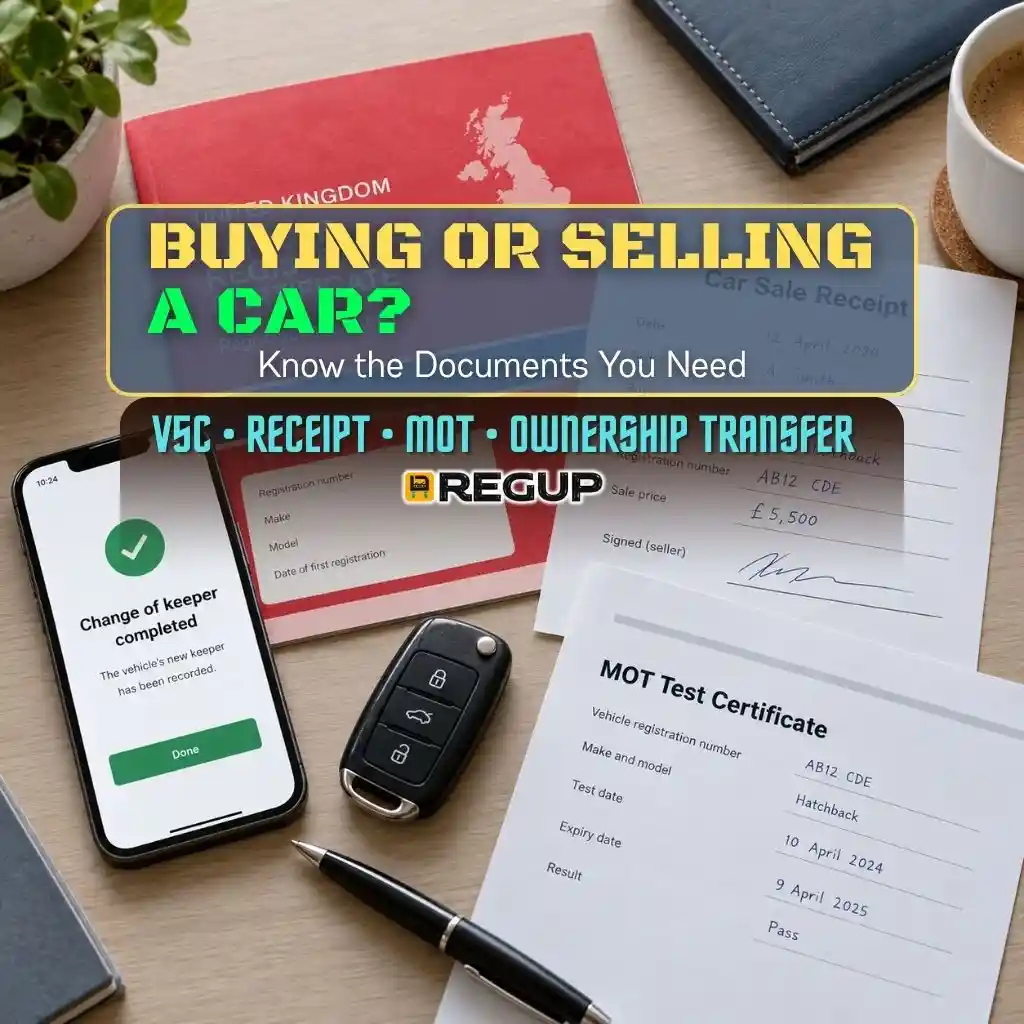
Key points
- The V5C proves who the registered keeper is. It does not prove legal ownership, and that distinction matters when finance is involved.
- The seller notifies DVLA. The buyer keeps the green new keeper slip until the new V5C arrives.
- A receipt signed by both parties is the buyer's main evidence in a private sale dispute.
- Vehicle tax is cancelled on sale and refunded to the seller in full months. It never transfers to the buyer.
- Failing to tell DVLA about a sale can mean a fine of up to £1,000, plus fines and penalties incurred by the new keeper.
The paperwork is the transaction
Money changing hands does not transfer a car. The documents do, and the gap between those two moments is where most private sale problems live.
A used car sale in the UK produces a record in three places: DVLA's keeper register, the buyer's and seller's own paperwork, and the vehicle's ongoing MOT and tax record. Get all three aligned on the day and the sale is clean. Leave one of them open and it can surface months later as a fine, an insurance problem or a dispute over what was agreed.
This guide covers both sides. If you are selling, it is the list of what to produce and what to send. If you are buying, it is the list of what to demand and how to verify it rather than take it on trust.
The V5C registration certificate
The V5C is the red log book, and it is the document everything else hangs off. It records the vehicle's registration mark, VIN, make, model, colour, engine size, date of first registration and the name and address of the registered keeper.
The point buyers most often misunderstand is that the V5C is not a title deed. It names the registered keeper, which is the person responsible for taxing and insuring the vehicle. It does not prove that the person holding it legally owns the car. A vehicle on hire purchase is legally owned by the finance company while the registered keeper is the driver.
That is why a V5C alone is not enough reassurance. Pair it with a car finance check before money moves, because an outstanding agreement means the finance company retains an interest in the vehicle regardless of what the log book says.
Check four things on the document itself. The VIN printed on it should match the VIN stamped on the car. The registration mark should match the plates. The keeper's name and address should match the person you are dealing with and the place you are standing in. And it should be an original DVLA document, not a photocopy or a scan.
If the details on the paper do not match the vehicle in front of you, stop. Run a VIN check to see what is actually recorded against that vehicle identification number, and read our guide on where to find the VIN number on a car so you are checking the right places.
Completing the V5C for a private sale
The current V5C has a dedicated green section for selling or transferring the vehicle to a new keeper. That is the section a private sale uses.
The seller completes the new keeper's full name and address and the date of sale, both parties sign it, and the seller sends that part to DVLA or completes the same notification online at the DVLA service. The online route is the better option because the change is registered immediately and the seller gets an email confirmation to keep as proof.
The seller then tears off the smaller green slip, the V5C/2, and hands it to the buyer. This is the new keeper slip. It is the buyer's temporary proof of keepership and it is what allows them to tax the car straight away. It is never sent to DVLA.
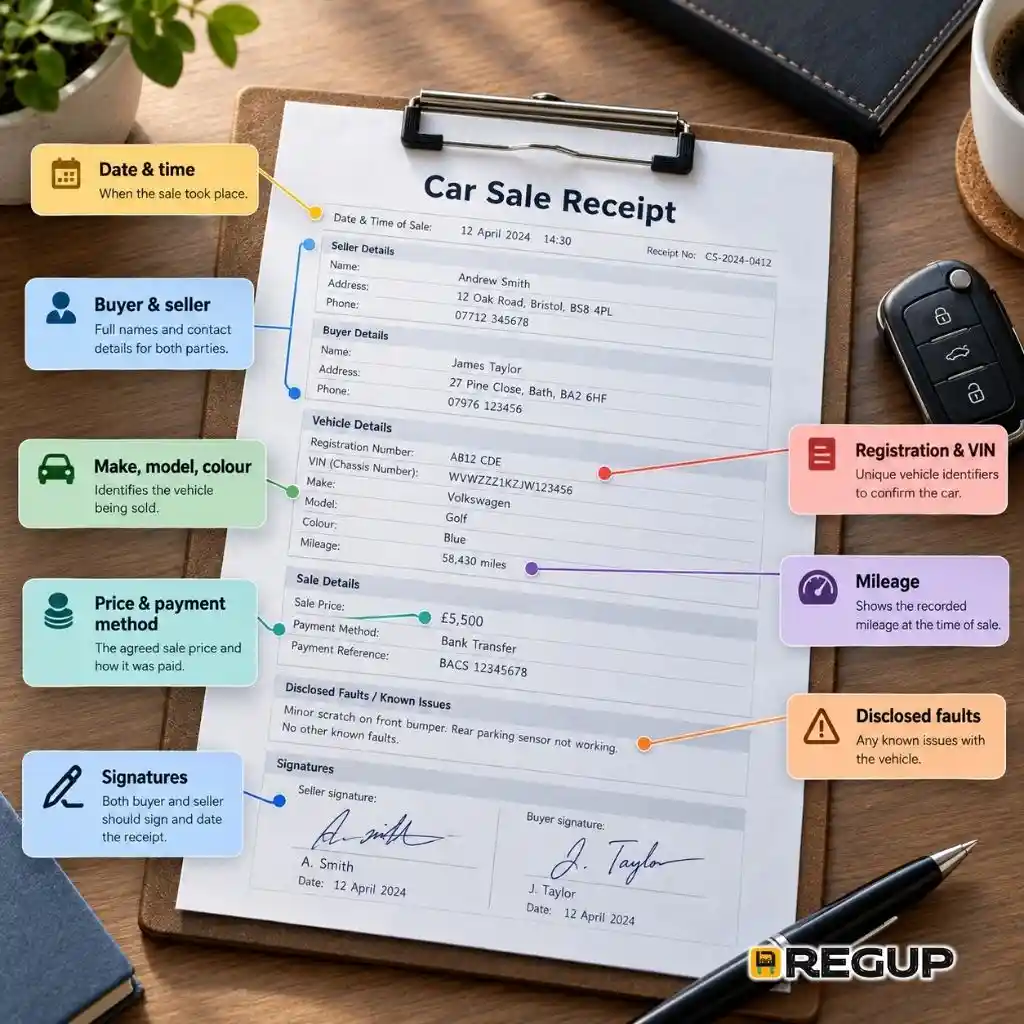
The seller keeps the remainder of the V5C until the confirmation arrives, then destroys it. The buyer should receive a new V5C in their own name by post, typically within a few weeks.
If you are selling to a dealer, a dismantler or an insurer instead of a private buyer, you use the separate yellow trade section rather than the green one. That section goes to DVLA and the trader keeps the rest of the document. Using the wrong section is the most common cause of a keeper record that does not update.
A missing log book is a warning sign, not a paperwork inconvenience. It is the most common thread in cloned and stolen vehicle sales because the document is the thing that would expose the mismatch.
If a seller says the V5C is lost, the correct answer is that they apply for a replacement before the sale. A registered keeper can order a duplicate from DVLA for £25, which usually arrives within a week. A seller who will not do that is asking you to buy a car with no proof of who has been keeping it.
Buyers sometimes accept a promise that the document will follow. It rarely does, and without it you cannot tax the vehicle or register yourself as keeper without a slower DVLA application that requires you to prove the purchase.
Before you even discuss it, run a free car check on the registration and a stolen car check. If the recorded details do not match what you are being told, the missing document has just explained itself.
The receipt of sale
There is no legal requirement for a written receipt in a private sale, which is precisely why you should insist on one. In a dispute, it is usually the only record of what was agreed.
Produce two identical copies, signed and dated by both parties, each keeping one. A useful receipt contains the full names and addresses of both buyer and seller, the date and time of sale, the registration mark and VIN, the make, model and colour, the recorded mileage at handover, the price paid and the payment method.
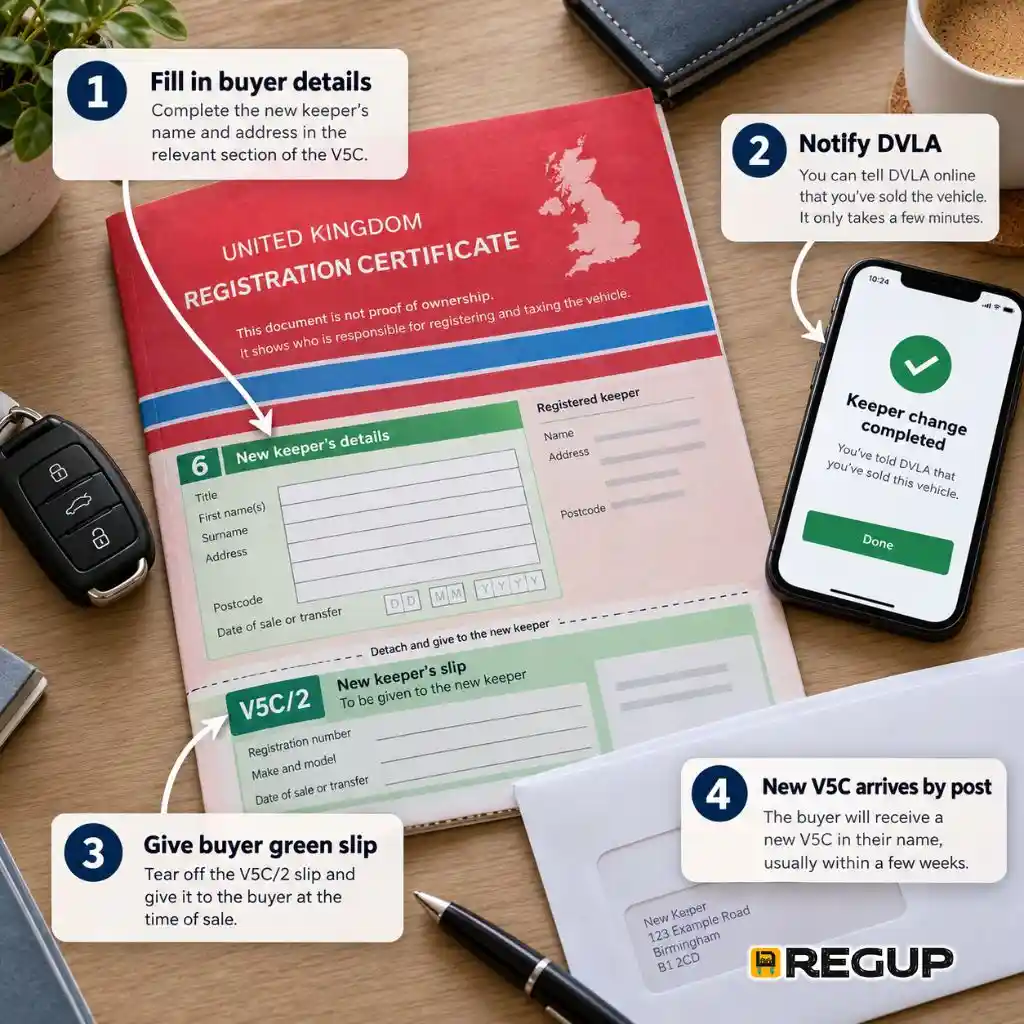
Add a line stating what was agreed about condition. If the car is being sold with known faults, list them. A seller who documents the faults is protected against a later claim of misrepresentation. A buyer who has them in writing has evidence of what was disclosed and what was not.
Avoid relying on the phrase "sold as seen". It carries far less legal weight than people assume. It cannot excuse a seller who described the car inaccurately, and it does not remove the requirement that the seller had the right to sell it in the first place. Our used car consumer rights guide explains what that phrase can and cannot do.
Record the mileage figure carefully and photograph the odometer at handover. That single number closes off a whole category of later argument, and it should match the reading in your mileage check.
MOT certificates and the MOT record
The current MOT certificate confirms the vehicle met the minimum roadworthiness standard on the day it was tested. That is all it confirms. It is not a condition report and it says nothing about the car three months later.
The more useful document is the full MOT history, which is a public record and free to view against any registration. It gives you a year by year timeline of test dates, results, mileage readings, failures and advisories.
Read it for continuity. Regular annual tests with mileage rising at a steady rate is what a normally used car looks like. Gaps, sudden mileage drops or a run of advisories that never get resolved all need explaining. Our guide to reading MOT mileage history covers how to interpret it, and you can pull the record directly with a MOT check.
If the car has failed a recent test or the certificate has expired, the rules on whether it can legally be driven are narrower than most people think. Our MOT failure and expiry guide sets out exactly when driving is permitted.
Sellers can request duplicates of past certificates, but in practice the online record is what buyers use and it cannot be altered by either party. That makes it the most trustworthy document in the whole transaction.
Service history and supporting receipts
Service history is the document set that most affects price and is most often overstated in adverts.
A full main dealer history means stamps or digital records from franchised dealers at the manufacturer's intervals. A full service history means the intervals were met, wherever the work was done. A partial history means gaps. Sellers use these terms loosely, so check the stamps against the claim rather than accepting the wording.
Loose receipts are worth more than people think. Invoices for a cambelt, a clutch, a turbo or a set of tyres tell you what has already been paid for and what you will not have to fund. A cambelt change on an older car is a genuine four figure saving.
Match the service dates and mileages against the MOT record. Two records that agree with each other are strong evidence. Two that contradict each other are a question you need answered before you pay.
Finance settlement, plates and other conditional documents
Some documents only apply to some sales, and each one signals something about the vehicle.
Finance settlement letter
If the car has been on hire purchase or a conditional sale agreement, the seller needs a settlement letter from the finance company confirming the balance has been cleared. Selling a car with undisclosed outstanding finance is unlawful. Buyers should verify independently rather than accept a letter at face value, and our guide on checking outstanding finance before buying explains the steps.
Private plate retention
A seller keeping a personalised registration must transfer or retain it before the sale using DVLA's retention process, which returns the vehicle to its original registration mark. Do not agree to handle this after the sale, because the registration on your receipt will no longer be the registration on the car.
Insurance write-off documentation
If the vehicle has been categorised, the seller should disclose it and the category should be recorded in a write-off check. Repair invoices and any post-repair inspection reports matter here more than usual.
Warranty paperwork
Manufacturer warranties often transfer to a new keeper, and any remaining cover is worth confirming in writing.
Owner's handbook, locking wheel nut key and second key
These are not legal documents, but each missing item is a real cost. A replacement key for a modern car with immobiliser coding is not a small bill.
The seller's side: what to do on the day and after
Selling is a shorter list, but the steps after the money arrives are the ones that protect you.
Before the buyer arrives, gather the V5C, the service history, all MOT certificates and receipts, both keys, the handbook and the locking wheel nut key. Clear any outstanding finance and have the settlement letter to hand.
At handover, complete the correct V5C section with the buyer's full details, sign it, and take a photograph of the completed section before you post it. Write the receipt in duplicate and get it signed. Note the exact mileage.
Notify DVLA the same day, ideally online. Your vehicle tax is cancelled automatically and refunded for any full months remaining, by cheque to the name and address on the V5C. Any direct debit is cancelled at the same time.
Then cancel or transfer your insurance, and remove any toll, congestion charge or parking permit registrations linked to the vehicle. If you do not notify DVLA, you remain the registered keeper on the record, which means penalty notices and enforcement letters intended for the new keeper come to you. The fine for failing to notify can reach £1,000.
The buyer's side: what to verify before you pay
Work through this in order, because each step is cheaper than the one after it.
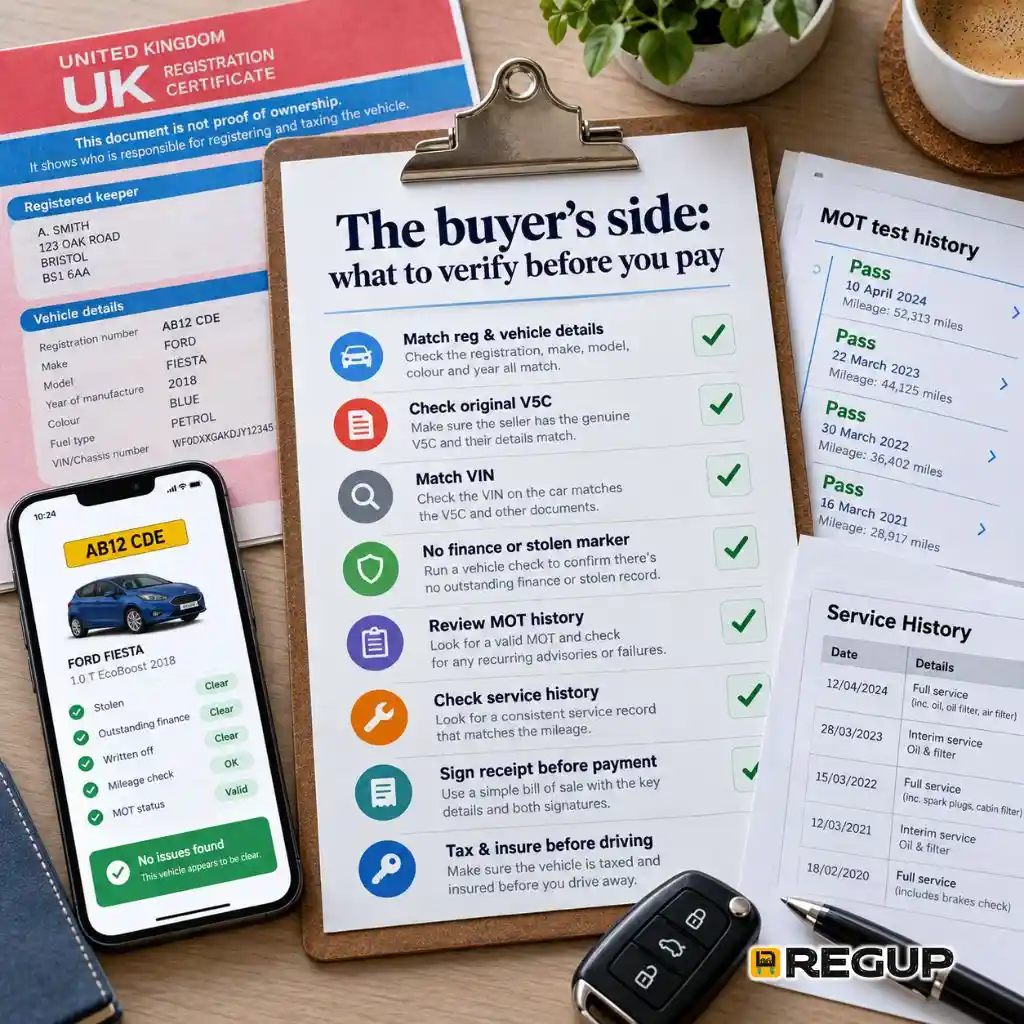
Check the registration against a report and confirm the make, model, colour, engine and fuel type match the advert.
Confirm the V5C is an original, and match the VIN on the document to the VIN on the vehicle.
Confirm the seller's name and address on the V5C match the person and the location.
Confirm no outstanding finance, no stolen marker and no undisclosed write-off category.
Compare the odometer reading against the MOT mileage timeline.
Read the MOT history for gaps and repeated advisories.
Check the service history against the claim made in the advert.
Agree the price, then write and sign the receipt before money moves.
Take the green new keeper slip and confirm the seller has notified DVLA.
Tax and insure the vehicle before you drive it away.
You can run the record based steps in a single pass with a pre-purchase used car check, or see what the output looks like first in a sample vehicle report.
The paperwork guidance published by AA Cars is a reasonable second opinion if you want to cross-check the document list.
Frequently asked questions
What documents do I legally need to sell a car in the UK?
The only document you must have is the V5C registration certificate, and you must notify DVLA of the change of keeper. Everything else, including the receipt, MOT certificates and service history, is not legally required but protects both parties and supports the price you achieve.
Does the V5C prove who owns the car?
No. The V5C names the registered keeper, which is the person responsible for taxing and insuring the vehicle. Legal ownership can sit elsewhere, most commonly with a finance company on a hire purchase agreement. This is why a finance check is a separate and necessary step.
What is the green slip when buying a car?
The green slip is the V5C/2 new keeper section, which the seller tears off and gives to the buyer at the point of sale. It is the buyer's temporary proof of keepership and allows the vehicle to be taxed immediately. It should never be sent to DVLA.
How long does it take to get a new V5C after buying a car?
If the seller notifies DVLA online, the new V5C is usually issued within about two weeks. Postal notifications take longer, often four to six weeks. If nothing has arrived after six weeks, the buyer should contact DVLA directly rather than the seller.
What should a car sale receipt include?
Both parties' full names and addresses, the date of sale, the registration mark and VIN, the make, model and colour, the mileage at handover, the price paid, the payment method, any faults disclosed, and signatures from both buyer and seller. Produce two copies so each side keeps a signed original.
Can I sell a car without a log book?
You can, but you should not. Apply to DVLA for a replacement V5C first, which costs £25 and usually arrives within a week. Selling without one drives the price down, limits your buyer pool, and makes a legitimate sale look like a suspicious one.
Do I get a tax refund when I sell my car?
Yes. Once DVLA is notified of the sale, the vehicle tax is cancelled and you are refunded for any full months remaining. The refund is issued to the name and address on the V5C. Tax does not transfer to the buyer, so they must tax the vehicle before driving it.