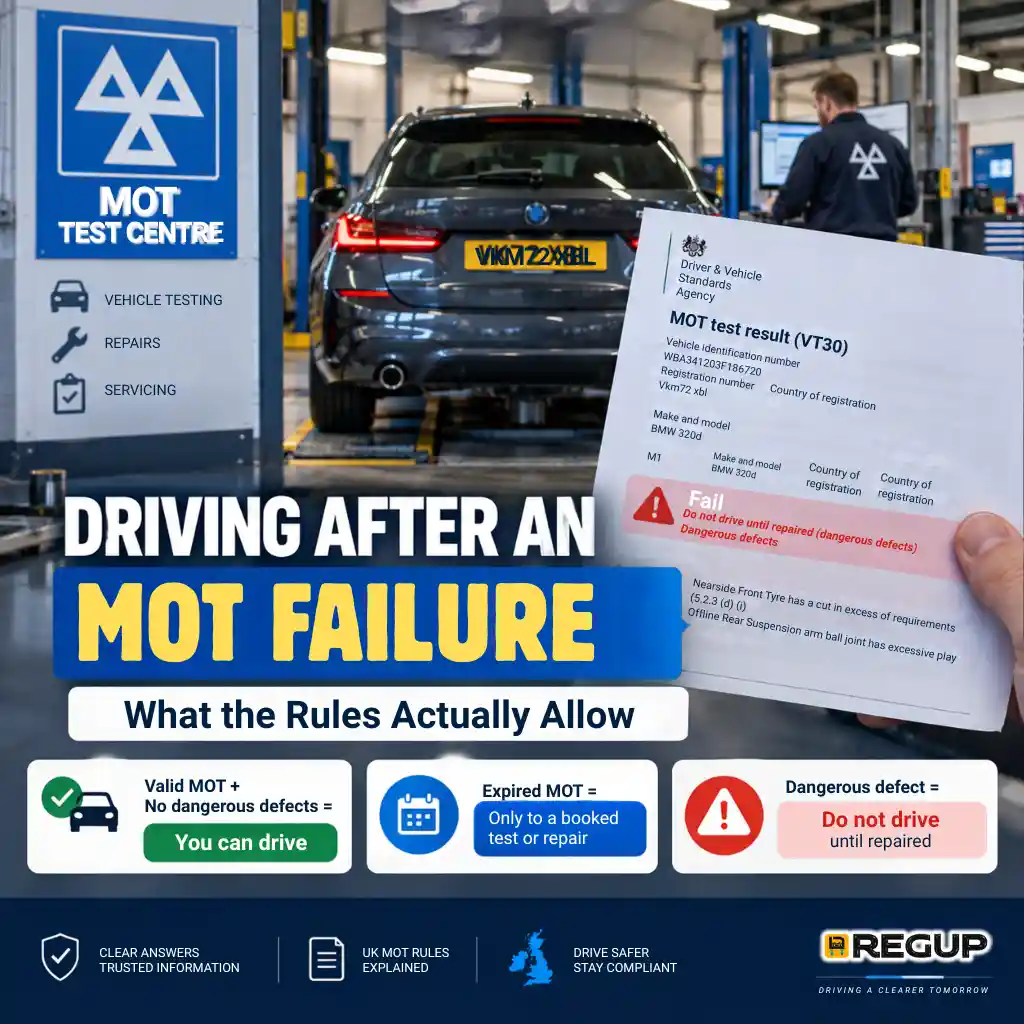
Key points
- A fail is triggered by a dangerous or a major defect. Minor items and advisories do not fail a vehicle.
- Driving with a dangerous defect can mean a fine of up to £2,500, three penalty points and a driving ban.
- Driving with no valid MOT can mean a fine of up to £1,000.
- Test up to one month minus a day before expiry and you keep your existing renewal date.
- A free partial retest is available if you leave the vehicle at the test centre, or return it before the end of the next working day.
The two questions that decide everything
Drivers leaving a test centre with a fail certificate almost always ask the same thing, and the answer depends on two facts rather than one.
First, is your previous MOT certificate still in date? Second, did the tester record any dangerous defects?
If the answer is yes to the first and no to the second, you can drive the car away legally, although the failure items still need fixing. If the answer is no to the first or yes to the second, you cannot drive it on a public road except to a pre-arranged test appointment or to a booked repair.
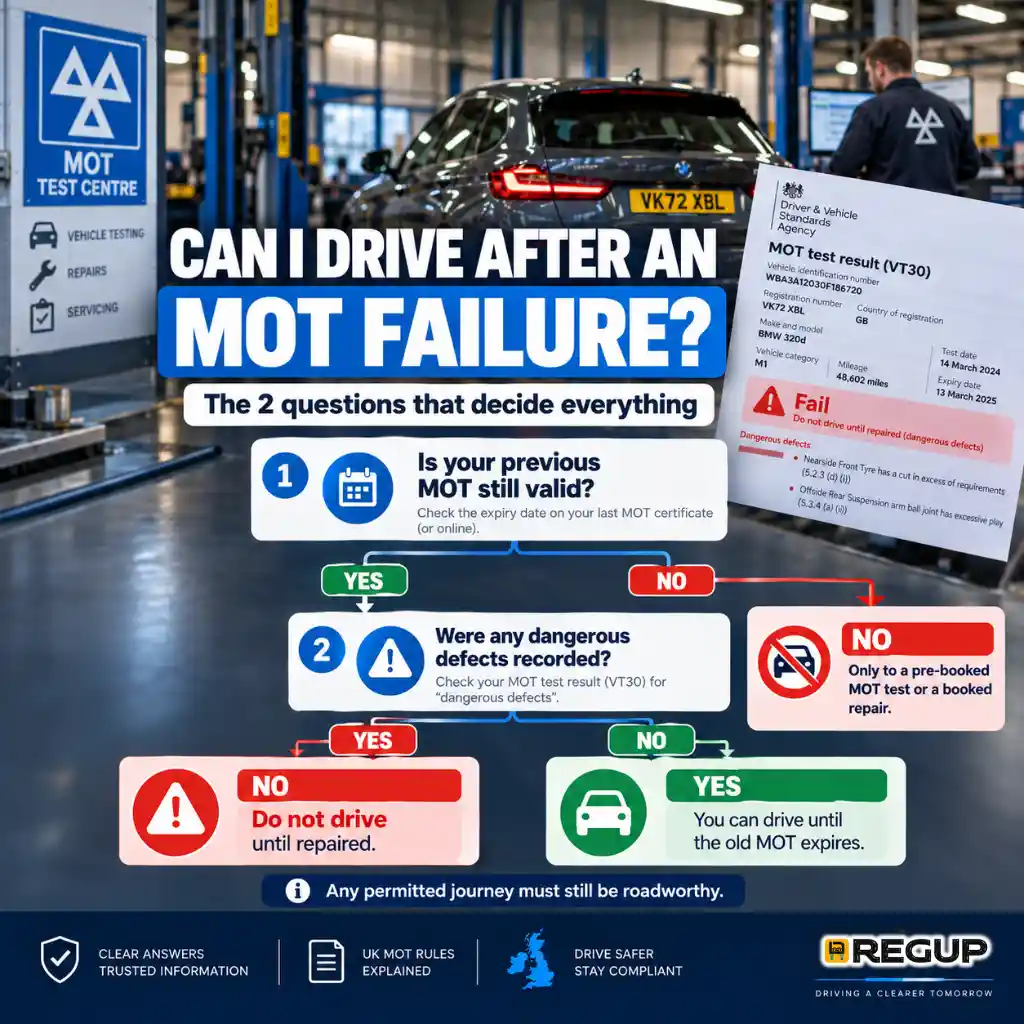
That is the whole rule. Everything else in this guide explains how the test produces those two facts, what it costs to put right, and what happens if you get it wrong.
Most people fail this test of knowledge in one specific way. They assume the fail certificate itself makes the car illegal to drive. It does not. It is the expiry of the previous certificate, or the presence of a dangerous defect, that stops you.
How the MOT produces a pass or a fail
Since the defect categories changed, an MOT result is no longer a simple two way outcome. The tester records each problem in one of four categories, and the categories decide the result.
- Dangerous. A direct and immediate risk to road safety, or a serious impact on the environment. Any dangerous item fails the test and the vehicle must not be driven until it is repaired, regardless of whether an old certificate is still valid.
- Major. May affect the vehicle's safety, put other road users at risk, or have a significant environmental impact. A major item fails the test and needs repairing, but it does not by itself make the vehicle illegal to drive if the previous certificate is still in date.
- Minor. No significant effect on safety or the environment. The vehicle passes, and the item should be repaired as soon as possible.
- Advisory. Something the tester wants to draw attention to because it is likely to become a problem later, such as a tyre approaching the limit or corrosion beginning on a structural area.
A pass produces an MOT certificate, which may still list minor items and advisories. A fail produces a VT30 refusal of an MOT test certificate. Both results are uploaded to the public MOT record within minutes, which is why a buyer can pull up the full history against any registration using a MOT check or a number plate check.
When you can legally drive away from a failed test
Take the two questions in order.
If your existing MOT certificate has not yet expired and no dangerous defects were recorded, you can drive the vehicle normally until that certificate runs out. Many people test early precisely so this window exists.
If your existing certificate has expired, you cannot drive except to a pre-arranged MOT appointment or to or from a place where the vehicle is being repaired. That exception is narrow and it does not cover a detour to work, the school run, or a trip home to think about it.
If any dangerous defect was recorded, you cannot drive the vehicle at all until that defect is repaired, even if your old certificate is still perfectly valid. The certificate does not override a live safety defect.
There is one more condition that catches people out. Even on a permitted journey to a repair or a test, the vehicle must still meet the minimum standards of roadworthiness. You cannot drive a car with no brakes to the garage and rely on the exemption.
What it costs when the answer is no
The penalties are structured around risk rather than paperwork, so the dangerous defect offence is far more serious than the expired certificate one.
Driving a vehicle with a dangerous defect can bring a fine of up to £2,500, three penalty points and a driving ban. That is a court level outcome, and it applies whether or not the defect was recorded at a test.
Driving without a valid MOT can bring a fine of up to £1,000. It is also usually a breach of your insurance policy conditions, which is the part that hurts more. An insurer can decline a claim or reduce a settlement where the vehicle had no valid test, leaving you personally exposed for third party damage.
There is a tax consequence as well. You cannot renew vehicle tax without a valid MOT, so an expired certificate quickly produces an untaxed vehicle too. If the car is going to be off the road while you sort out repairs, declare it SORN rather than letting the tax lapse quietly. You can confirm the current position with a road tax check or view tax and test status together with a tax and MOT check.
Retests: when they are free and when they are not
The retest rules reward acting quickly, and they are worth knowing before you decide where to have repairs done.
If you leave the vehicle at the test centre for the repairs and it is retested within 10 working days, you get a free partial retest. No fee at all.
If you take the vehicle away for repair and return it to the same test centre before the end of the next working day, you also get a free partial retest. This covers a long list of around 40 items including brakes, lamps, wipers, seat belts, mirrors and tyres, though a few items such as headlamp aim and seat belt anchorages need a full test.
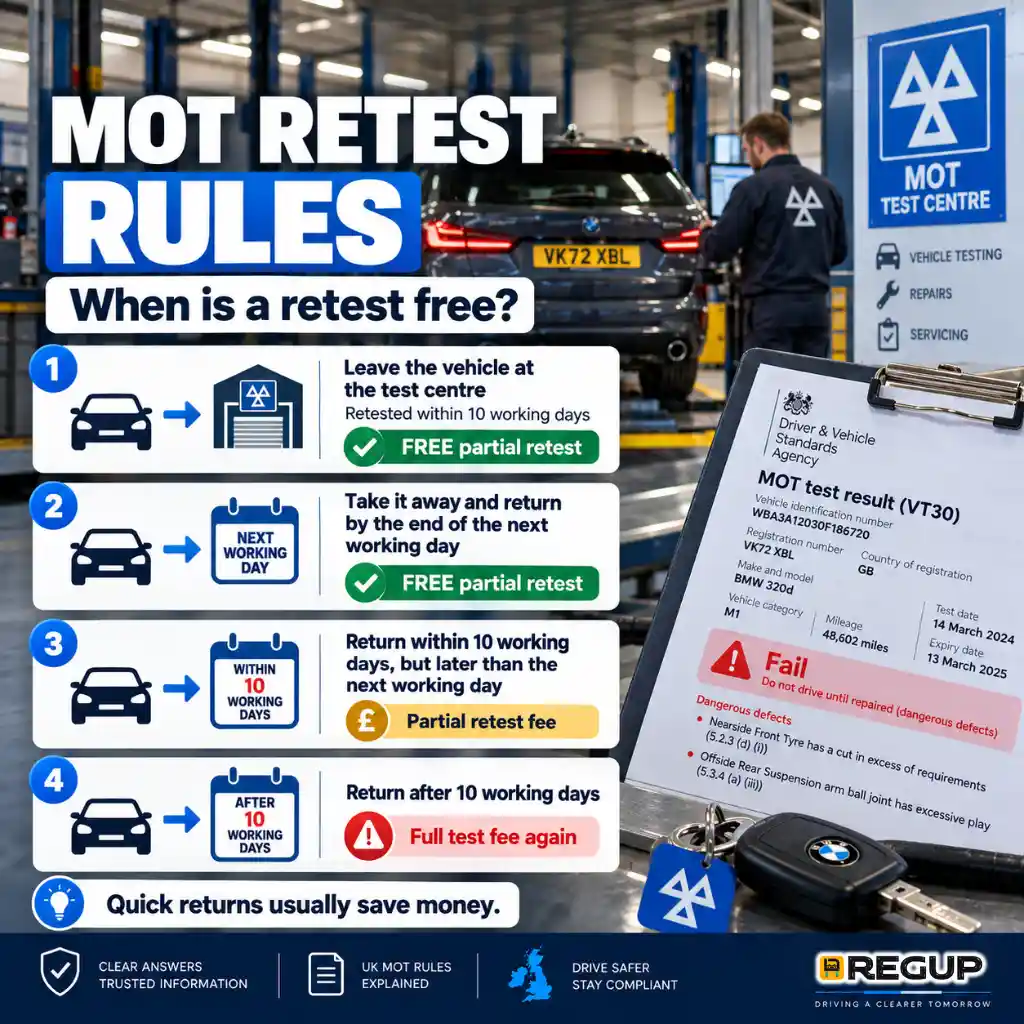
If you take the vehicle away and bring it back within 10 working days but not by the next working day, a partial retest fee applies.
If more than 10 working days pass, you pay the full test fee again.
The practical takeaway is that returning the car quickly, or leaving it with the testing garage, is usually the cheaper route. Dragging the repair out for a fortnight adds a full test fee to the bill.
MOT fees and what a test should cost
There is a legal maximum a test station can charge, and many garages charge well below it.
For a standard car with up to eight passenger seats, the maximum fee is £54.85. Motor caravans and dual purpose vehicles in the same class share that figure. Goods vehicles up to 3,000kg are also £54.85, and goods vehicles between 3,000kg and 3,500kg are £58.60.
Motorcycles are £29.65, and a motorcycle with a sidecar is £37.80.
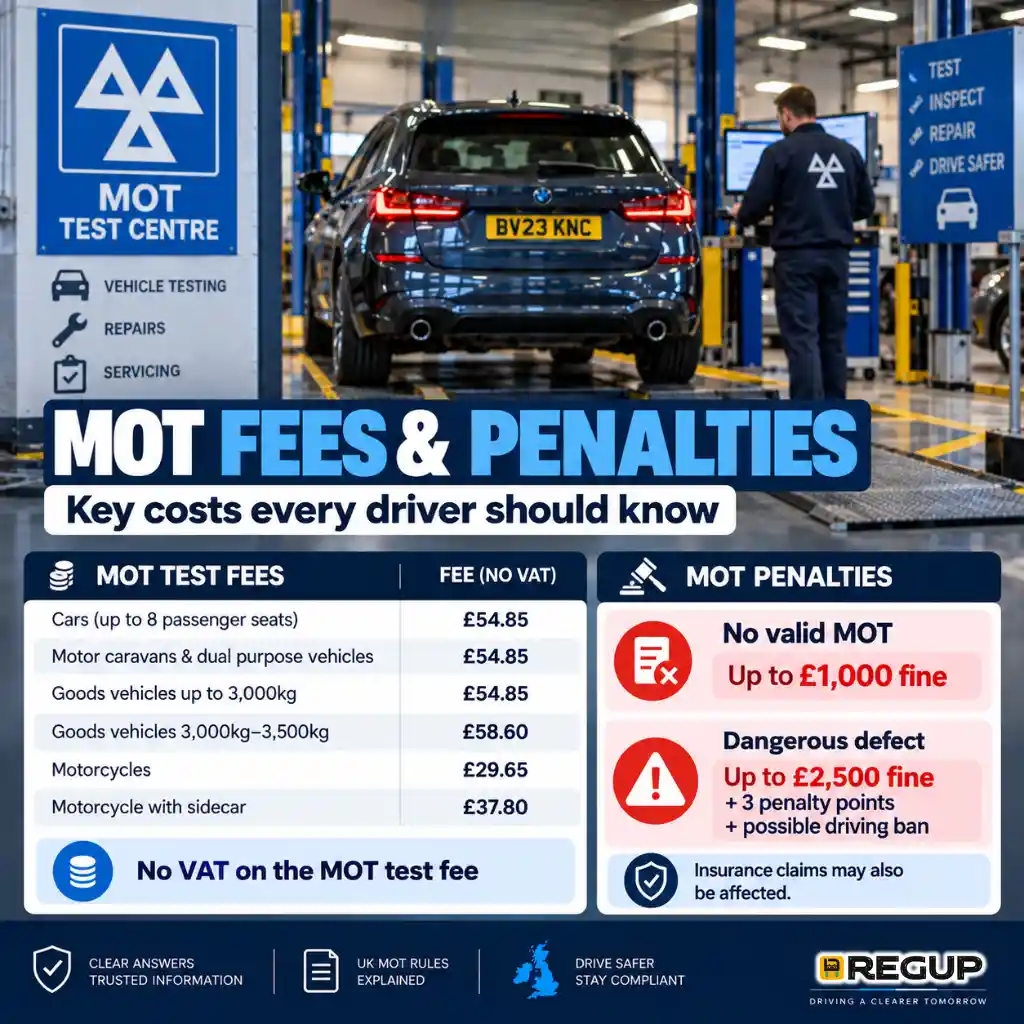
There is no VAT on an MOT fee, so an invoice showing VAT added to the test itself is wrong.
A garage quoting under the cap is not cutting corners on the test, because the test standard is set by DVSA and does not vary by price. Cheap MOTs are usually a route to selling repair work, which is fine as long as you are free to take the car elsewhere for the repairs and return it in time for a free retest.
Testing early without losing your renewal date
This is the most useful piece of MOT admin most drivers do not use.
You can have the vehicle tested up to one month minus a day before the current certificate expires and keep the same renewal date. If your MOT runs out on 15 May, you can test from 16 April onwards and your next expiry will still be 15 May.
Test any earlier than that and the new expiry is set to one year from the test date, which quietly shortens the life of your certificate. Testing two months early costs you a month of cover every time you do it.
The reason to use the early window is failure risk. Testing with three weeks still on your old certificate means that if the car fails on a major defect and nothing dangerous is recorded, you can still drive it while the repair is arranged. Testing on the day of expiry removes that safety margin entirely.
If you are buying a car with an MOT about to expire, factor this in. A vehicle sold with two weeks of test remaining may be about to need work that the seller has already anticipated. Reading the last few results in the MOT history tells you whether the advisories have been accumulating.
Reading a failure the way a buyer should
A failed MOT on a car you are thinking of buying is information, not automatically a reason to walk away. What matters is the pattern.
A single failure on consumable items, such as tyres, bulbs, wipers or brake pads, followed by a pass a few days later, is a normally maintained car. Those parts wear out.
Repeated failures on the same system across several years suggest something that keeps being patched rather than fixed. Failures on structural corrosion, suspension mounting points or brake pipes are the expensive category and tend to get worse.
Repeated structural corrosion advisories are also worth checking against a write-off check, because poorly repaired accident damage often shows up first as corrosion in the same area. Advisories that appear one year and become failures the next tell you the owner was reactive rather than preventative. Advisories that appear and then disappear tell you the opposite.
Cross-reference the mileage recorded at each test at the same time. A car that covers very few miles between tests but keeps failing on corrosion has probably been standing. Our guide to reading MOT mileage history covers how to read those two data sets together, and a mileage check gives you the full timeline.
If you are working through a purchase, the used car buying guide puts the MOT record in the context of the other checks, and the car sale documents guide covers which certificates the seller should hand over.
Appealing a result you disagree with
You can challenge both a failure you think was wrong and a pass you think was issued incorrectly.
Raise it with the test centre first. Many disagreements are resolved at the counter, particularly where a defect was borderline. If that does not work, you can appeal to DVSA, normally within 14 working days of the test for a failure.
Do not repair the disputed item before the appeal is decided, because the evidence disappears with the repair. DVSA may inspect the vehicle, and there is usually a fee that is refunded if your appeal succeeds.
Keep the VT30 and any paperwork from the garage. As with most disputes, the person with the documentation is in the stronger position. The advice pages published by the RAC are a useful neutral reference on how the process works in practice.
What to do in the first hour after a failure
Read the VT30 and identify whether any defect is marked dangerous.
Check the expiry date on your previous certificate.
If there are no dangerous defects and the old certificate is still valid, you can drive. Book the repair anyway.
If either condition fails, arrange for the repair at the test centre or book a garage and drive only that journey.
Ask whether leaving the vehicle for repair qualifies you for a free partial retest.
If you take it away, aim to return it before the end of the next working day.
If the repair will take longer than a few days and the tax is due, consider declaring the vehicle SORN.
Get quotes on the failure items separately if the bill looks high. You are not obliged to have the work done where you tested.
If the failure appeared on a car you bought recently, what you can claim depends on who sold it to you, and our used car consumer rights guide sets out the position. If you are still choosing a car, run the full record set with a pre-purchase used car check or view a sample vehicle report first.
Frequently asked questions
Can I drive my car after it fails its MOT?
Only if your previous MOT certificate is still valid and no dangerous defects were recorded. If the old certificate has expired, or any dangerous defect was found, you can only drive to a pre-arranged MOT test or to and from a booked repair.
What is the difference between a major and a dangerous MOT defect?
A major defect may affect safety or the environment and fails the test, but it does not stop you driving if your previous certificate is still valid. A dangerous defect is an immediate risk to road safety and means the vehicle must not be driven at all until it is repaired.
How long can I drive after my MOT expires?
You cannot. Once the certificate expires there is no grace period. The only permitted journeys are to a pre-arranged MOT test appointment or to and from a place where the vehicle is being repaired, and the vehicle must still be roadworthy for those journeys.
Is an MOT retest free?
It is free if you leave the vehicle at the test centre for repair and it is retested within 10 working days, or if you take it away and return it to the same centre before the end of the next working day. Returning later than that within 10 working days brings a partial retest fee, and after 10 working days you pay the full fee again.
How early can I get an MOT without losing the renewal date?
Up to one month minus a day before the current certificate expires. Testing within that window keeps your existing renewal date. Testing earlier resets the expiry to one year from the new test date, which shortens your cover.
What is the fine for driving without an MOT?
Up to £1,000 for driving without a valid MOT certificate. If the vehicle has a dangerous defect, the penalty rises to a fine of up to £2,500, three penalty points and a possible driving ban. Driving without a valid test can also affect an insurance claim.
Does a failed MOT show up on a vehicle history check?
Yes. Test results, including failures, the defects recorded and the mileage at the time, are added to the public MOT record and appear against the registration. Buyers can see the full test history, which is why the record is a reliable way to assess how a car has been maintained.