
Key points
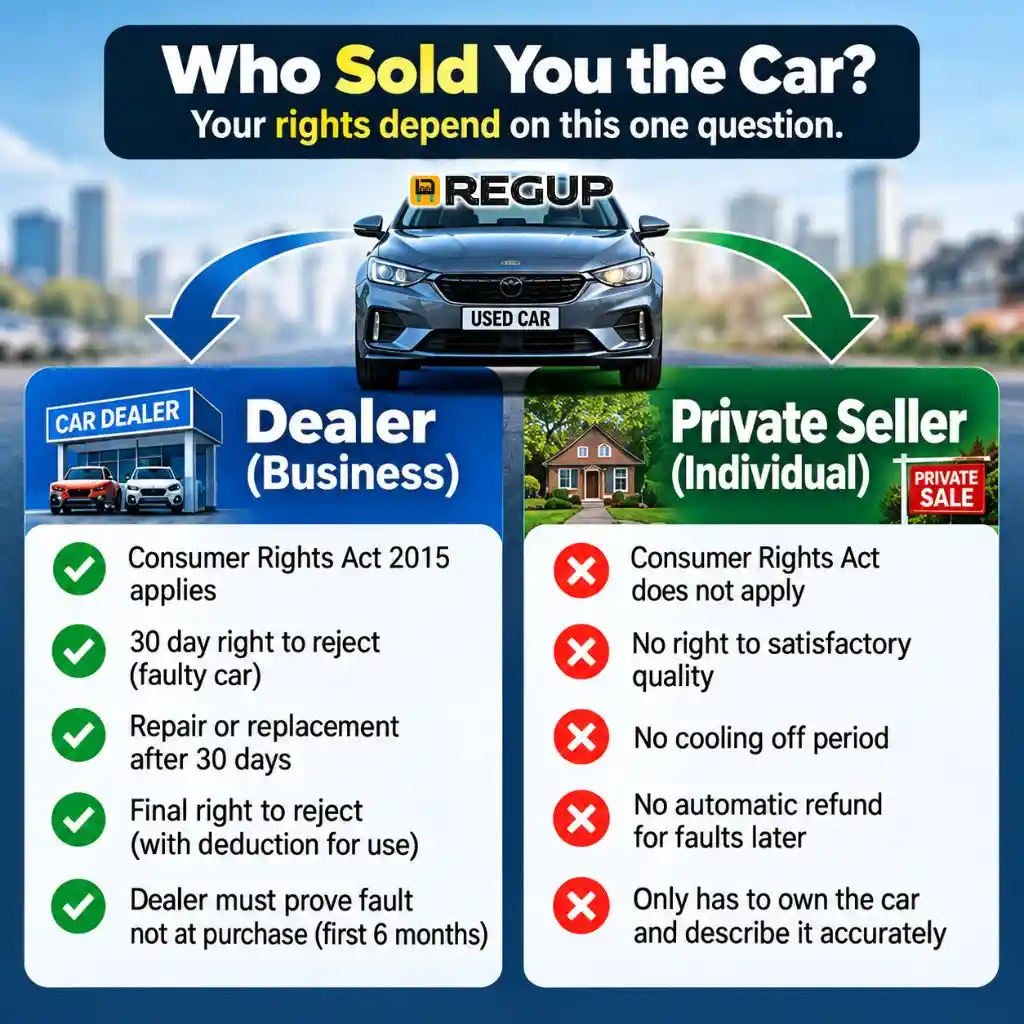
- Who sold you the car decides your rights far more than what is wrong with it.
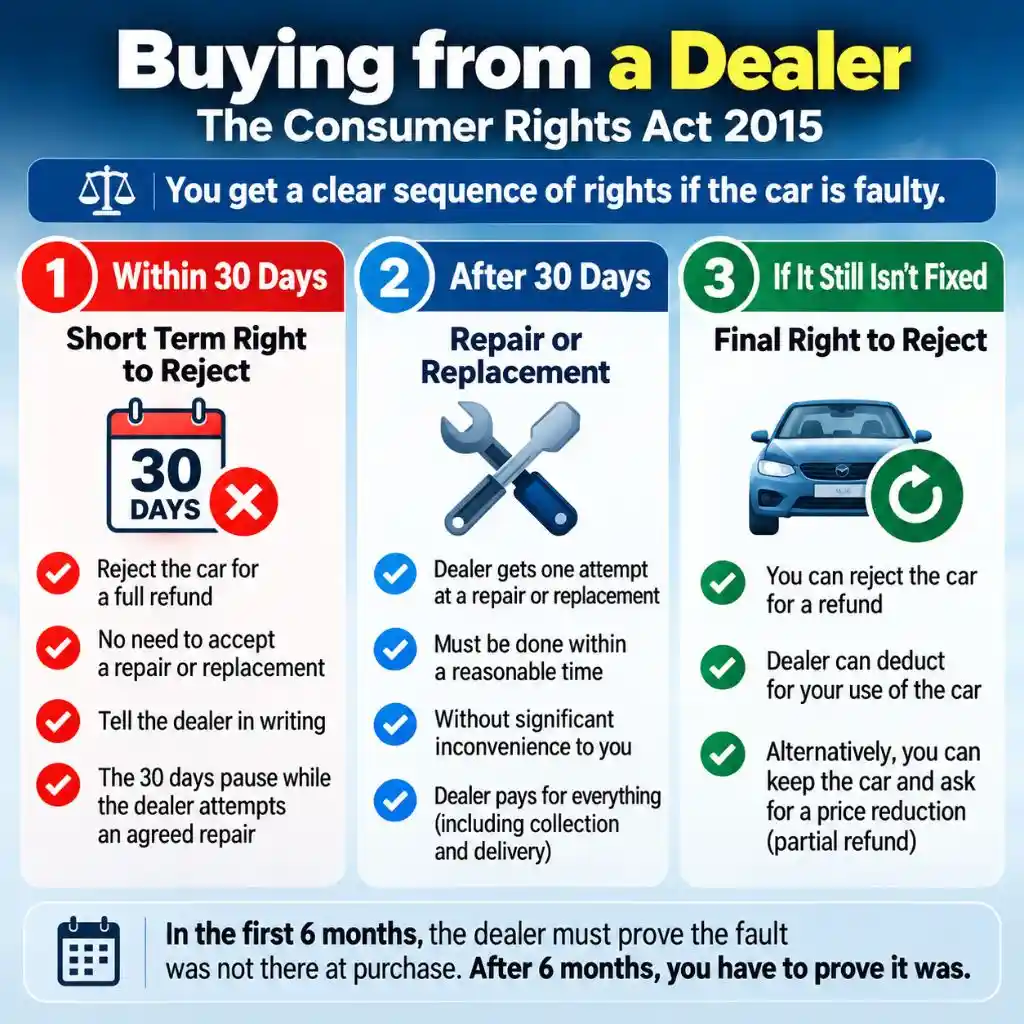
- Dealer purchase: 30 day short term right to reject, then one repair attempt, then a final right to reject with a deduction for use.
- In the first six months after a dealer sale, the dealer has to prove the fault was not there at purchase. After six months, you have to prove it was.
- Private sale: no right to satisfactory quality, no cooling off period, and no automatic refund for faults that appear later.
- "Sold as seen" does not protect a seller who described the car inaccurately.
Start with who sold you the car
Every question about used car rights in the UK resolves to the same first question. Was the seller a business or a private individual?
That single fact determines which law applies, what you can demand, and how long you have to demand it. A gearbox failure three weeks after purchase is a strong claim against a dealer and, in most cases, no claim at all against a private seller.
Buyers get caught out because the transaction feels identical. Same car, same money, same handshake. The legal position underneath is not remotely the same, and the time to understand that is before you choose where to buy, not after something breaks.
This guide sets out both positions, what to do in each, and where the edges are. It is general information rather than legal advice, and if a large sum is involved it is worth taking proper advice on your specific facts.
Buying from a dealer: the Consumer Rights Act 2015
When a business sells to a consumer, the Consumer Rights Act 2015 applies automatically. It cannot be signed away, disclaimed in the small print, or removed by anything the dealer writes on the invoice.
The Act requires the car to meet three standards. It must be of satisfactory quality, judged by what a reasonable person would expect given the age, mileage and price. It must be fit for purpose, meaning fit for normal driving and for any specific purpose you told the dealer about. And it must be as described, matching the advert, the specification and anything the salesperson told you.
Satisfactory quality is relative, and that is the part buyers argue about most. A twelve year old car with 140,000 miles is not expected to perform like a three year old one. Worn brake pads on a high mileage car are normal wear. A failed timing chain at 200 miles after purchase is not.
Faults present at the point of sale are the ones that count, even if they only became obvious later. A clutch that was already near the end of its life when you bought it is a sale fault. A clutch you burned out yourself is not.
The three remedies, in order
The Act gives you a sequence rather than a menu. Each stage unlocks the next.
Stage one: the short term right to reject, within 30 days. If a fault appears within 30 days of taking delivery, you can reject the car and ask for a full refund. You do not have to accept a repair, and you do not have to accept a replacement. Tell the dealer in writing, clearly, that you are rejecting the vehicle under your short term right to reject. The 30 days pause while the dealer is attempting an agreed repair.
Stage two: repair or replacement, after 30 days. Once the 30 days have passed, the dealer is entitled to one attempt at a repair or a replacement. It must be done within a reasonable time and without significant inconvenience to you, and the dealer pays for everything including collection and delivery.
Stage three: the final right to reject, or a price reduction. If that repair fails, or the same fault returns, you can either keep the car and claim a reduction in price, or reject it for a refund. After the first six months, the refund can be reduced to reflect the use you have had, usually calculated on the miles you have added.
Time limits sit behind all three. You can generally bring a claim for up to six years in England, Wales and Northern Ireland, and five years in Scotland, although in practice proving a fault existed at sale gets harder the longer you wait.
The six month rule that decides most disputes
This is the most valuable part of the Act and the part dealers hope you do not know.
If a fault appears within the first six months of a dealer purchase, the law assumes it was present at the point of sale. The dealer has to prove it was not. That reverses the usual burden of proof and it is why early complaints succeed far more often than late ones.
After six months, the position flips. You have to prove the fault existed at the point of sale, which normally means paying for an independent engineer's report. Those reports cost money and they do not always reach a clear conclusion.
The practical consequence is simple. Report faults immediately, in writing, and do not let a dealer talk you into "keeping an eye on it" for a few months. Delay moves the burden of proof from them to you.
Keep a dated record of every contact, every symptom, and every workshop visit. In a dispute, the buyer with a timeline usually wins.
Buying privately: a much narrower set of rights
The Consumer Rights Act does not apply to private sales. Private sellers are not businesses, so they carry none of the obligations around satisfactory quality or fitness for purpose.
What survives is narrow but real. Under the Sale of Goods Act 1979, a private seller must have the legal right to sell the vehicle, and the vehicle must match the description given. Beyond that, mechanical condition is the buyer's problem.
So a car that develops a fault a fortnight later is, in almost all cases, simply your car with a fault. There is no right to reject, no cooling off period, and no obligation on the seller to repair anything.
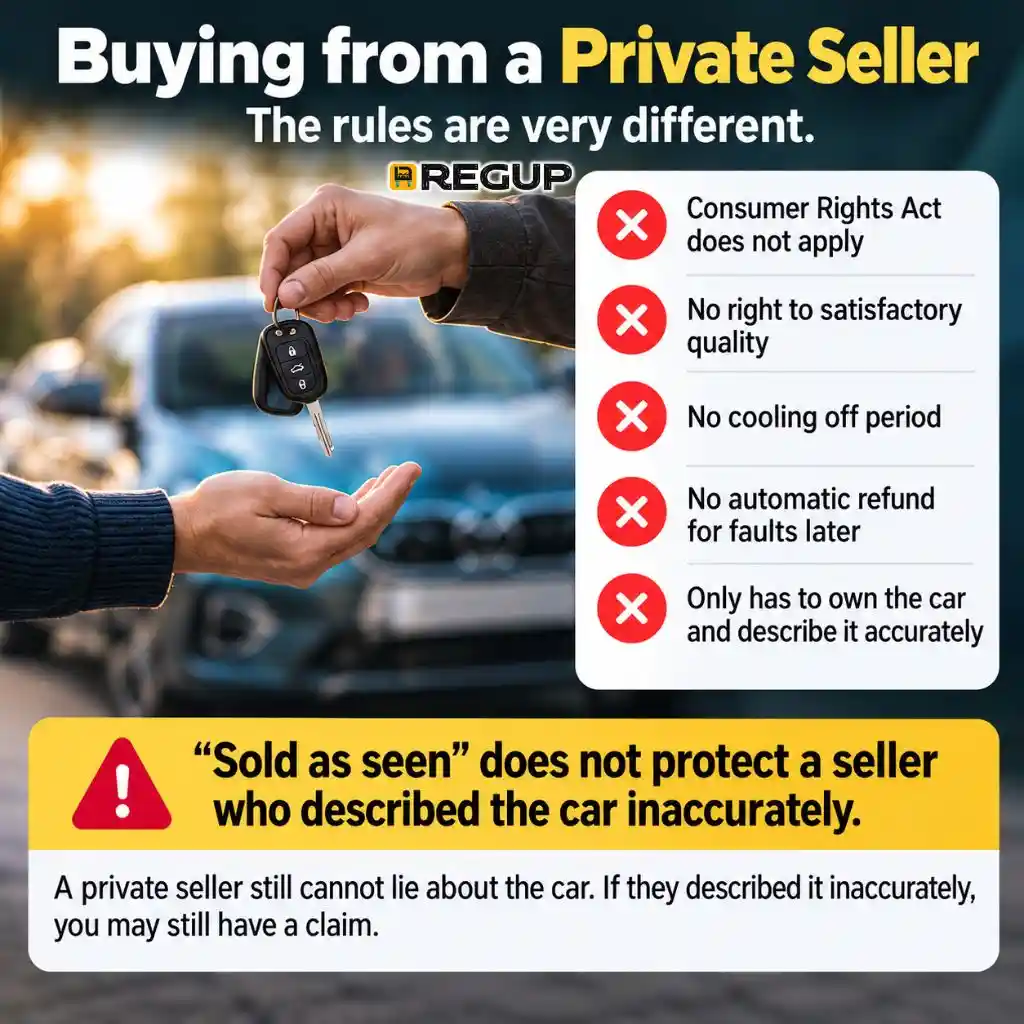
Two situations are different. If the seller did not have the right to sell, for example because the car was still on finance or was stolen, you have a claim and the sale is defective at its root. And if the seller made a false statement of fact that you relied on when buying, that is misrepresentation under the Misrepresentation Act 1967, and you may be able to unwind the sale or claim damages.
The difference between an opinion and a statement of fact matters here. "It's a lovely car" is sales talk. "It has full service history", "it has never been in an accident" or "the mileage is genuine" are statements of fact, and if they are untrue you have something to work with.
Because private rights are so limited, the checks you run before paying are doing the work that the law does for you in a dealer sale. That is the whole argument for running a pre-purchase used car check before a private purchase rather than after it.
What "sold as seen" actually means
Sellers write it on receipts and adverts believing it removes all responsibility. It does not, and the belief cuts both ways.
In a dealer sale, "sold as seen" has essentially no effect. The Consumer Rights Act cannot be excluded by a term in a contract, so a dealer using the phrase is either misinformed or hoping you are.
In a private sale, the phrase carries more weight but still has limits. It signals that the buyer accepted the car in its visible condition, and it makes a claim about general wear harder to run. It does not excuse a seller who lied about the history, concealed a write-off category, misstated the mileage or sold a car they did not own.
For sellers, the useful version of that phrase is specificity. Writing "sold as seen" is weak. Writing "buyer is aware the clutch is noisy, the air conditioning does not work and the nearside rear tyre is below 3mm" is strong, because it documents exactly what was disclosed.
For buyers, treat the phrase as a prompt to inspect harder and to get any claim about history in writing. Our car sale documents guide covers what a properly written receipt should contain.
Auctions, online purchases and part exchanges
Three other buying routes each shift your position again.
Auctions. Auction houses generally sell under their own terms and conditions, and those terms usually limit your ability to return a vehicle. Many lots are sold as seen with no warranty. If the vehicle is sold on behalf of a private seller, consumer protections are further reduced. Read the catalogue conditions before you bid, not after.
Online and distance purchases from a dealer. Buying a car online or over the phone from a business, without visiting the premises, brings the Consumer Contracts Regulations 2013 into play. These give a 14 day cancellation right that has nothing to do with whether the car is faulty. You can change your mind. Our guide to buying a car online sets out how the window works and what deductions the dealer can make.
Part exchange. If you reject a car you part exchanged into, you are entitled to the value of the part exchange as agreed, not the return of your old car, which the dealer will usually have sold. Make sure the part exchange value is recorded clearly on the invoice.
Faults a data check would have caught
Some disputes are not really about mechanical faults at all. They are about facts that were on the record before the sale.
Undisclosed write-off categories are the most common. A repaired Category S or N vehicle is legal to sell, but the category must be disclosed and reflected in the price. If it was not, that is a misdescription in a private sale and a breach of the "as described" standard in a dealer sale. A write-off check confirms what is recorded, and our comparison of Cat S and Cat N explains the practical difference.
Mileage discrepancies are next. Clocking is fraud, and MOT readings make it visible. If the recorded mileage timeline does not support the odometer, you have strong evidence. Read our guidance on mileage discrepancies on a used car and confirm the record with a mileage check.
Outstanding finance is the most serious, because it goes to the seller's right to sell at all. The finance company can recover the vehicle from you. A car finance check before payment avoids the entire problem.
Stolen markers work the same way and are recoverable by police without compensation. A stolen car check takes seconds.
None of these require a mechanic. They require a record check before money moves, which is the cheapest insurance in the whole process. Our blog on whether a car check is worth it puts the cost in context.
How to complain, step by step
A structured complaint succeeds far more often than an angry one. Work through it in this order.
Stop driving the car if the fault is safety related, and note the date the problem appeared.
Gather your evidence: the advert, the invoice, the receipt, the V5C, the MOT record, any messages with the seller, photographs, and any diagnostic printout.
Write to the seller. Not a phone call, not a message that disappears. State the fault, the date it appeared, the date of purchase, and exactly what you want: rejection and refund, or repair.
Name the remedy and the law. For a dealer, refer to the short term right to reject under the Consumer Rights Act 2015 if you are inside 30 days.
Give a clear deadline, usually 14 days, and keep a copy of everything.
If you paid any part by credit card and the price was over £100, contact your card provider about a section 75 claim. If you paid by debit card, ask about chargeback.
If the dealer belongs to a trade body or an ombudsman scheme, escalate there next. Alternative dispute resolution is cheaper and faster than court.
If it is unresolved, the small claims track handles most used car values without a solicitor.
For private sales, the same structure applies but your claim is framed around misrepresentation or the seller's right to sell rather than quality. The consumer guidance from Citizens Advice is a good starting point, and The Motor Ombudsman publishes clear explanations of how the Act applies to vehicles.
Reducing the risk before you buy
Rights are a remedy. Checks are prevention, and prevention is cheaper.
Choose the seller type deliberately rather than by accident. A dealer purchase costs more and carries statutory protection. A private purchase costs less and transfers the risk to you. Neither is wrong, but you should know which trade you are making.
Before any purchase, run the registration and confirm there is no finance, no theft marker, no undisclosed write-off and no mileage inconsistency. Read the MOT history for continuity, and drive the car properly using our test drive guide before you commit. Confirm the specification against a car specification check so "as described" is something you have verified rather than assumed.
Then document everything. Screenshot the advert before it disappears. Keep the messages. Get the receipt signed. The buyer who can produce the original advert six weeks later is in a much stronger position than the buyer who remembers what it said.
Our used car buying guide covers the full process, and a sample vehicle report shows what the record looks like before you commit to anything.
Frequently asked questions
Can I return a used car bought from a dealer?
If a fault appears within 30 days of taking delivery, you can reject the car under the Consumer Rights Act 2015 and ask for a full refund. If you simply changed your mind and bought in person at the premises, there is no automatic right to return it. Buying online or over the phone is different and brings a 14 day cancellation right.
What rights do I have buying a car from a private seller?
Limited ones. The seller must have the legal right to sell the vehicle and must describe it accurately. There is no requirement for satisfactory quality or fitness for purpose, no cooling off period, and no right to reject for faults that appear after the sale unless the car was misdescribed.
Does "sold as seen" remove my rights?
Not entirely. In a dealer sale it has no effect, because the Consumer Rights Act cannot be excluded by a contract term. In a private sale it makes a claim about ordinary wear harder, but it does not protect a seller who lied about the car's history, mileage, accident damage or ownership.
How long does a dealer have to fix a faulty car?
The Act says a repair must be carried out within a reasonable time and without significant inconvenience to you. What counts as reasonable depends on the fault and parts availability, but weeks without a courtesy vehicle or a clear timeline is usually unreasonable. If the repair fails, you move to the final right to reject.
What is the six month rule for used cars?
For a fault that appears within six months of a dealer purchase, the law assumes it was present at the point of sale and the dealer must prove otherwise. After six months, the burden moves to you to prove the fault existed at sale, which usually means paying for an independent inspection report.
Can I claim if the car had undisclosed accident damage?
Usually yes. An undisclosed write-off category or repaired structural damage is a failure of the "as described" standard in a dealer sale, and can amount to misrepresentation in a private sale. A write-off check run before purchase gives you the recorded position, and run afterwards it gives you evidence.
Does the Consumer Rights Act cover cars bought at auction?
Often not in the way buyers expect. Auction terms typically restrict returns, and where the vehicle is sold on behalf of a private seller, consumer protections are reduced further. Read the auction house's conditions of sale before bidding, because those terms define your position.