Key points
- Cat N is usually safer because the damage does not reach the vehicle's structure.
- Cat S involves structural damage and requires DVLA re-registration before returning to the road.
- Both Cat S and Cat N vehicles can legally return to UK roads after repair.
- Repair quality matters more than the category alone.
- Cat S usually carries a larger value reduction than Cat N.
- Insurance can be more restricted and expensive for written-off vehicles.
- Independent inspection is essential for a repaired Cat S vehicle.
- Repair invoices, photographs and body shop records provide important evidence.
- A write-off category remains on the vehicle record permanently.
- A vehicle history check should be completed before buying a written-off car.
Cat S vs Cat N: Which write-off is Safe to Buy?
Cat N is usually the safer buy, because the damage never touched the car's structure. Cat S can still be a sound purchase, but only with proof of who repaired it and how.
The category itself is not the thing that should decide it for you. It tells you what type of damage happened. It tells you nothing about how well the car was put back together, and that is the part that affects whether it protects you in the next crash.
This guide covers what each category means, which is riskier, what you should pay, what to inspect, and how to confirm a car's category before you commit. If you already have a registration, run a write-off check first and read this with the result in front of you.
What Cat S and Cat N Actually Mean
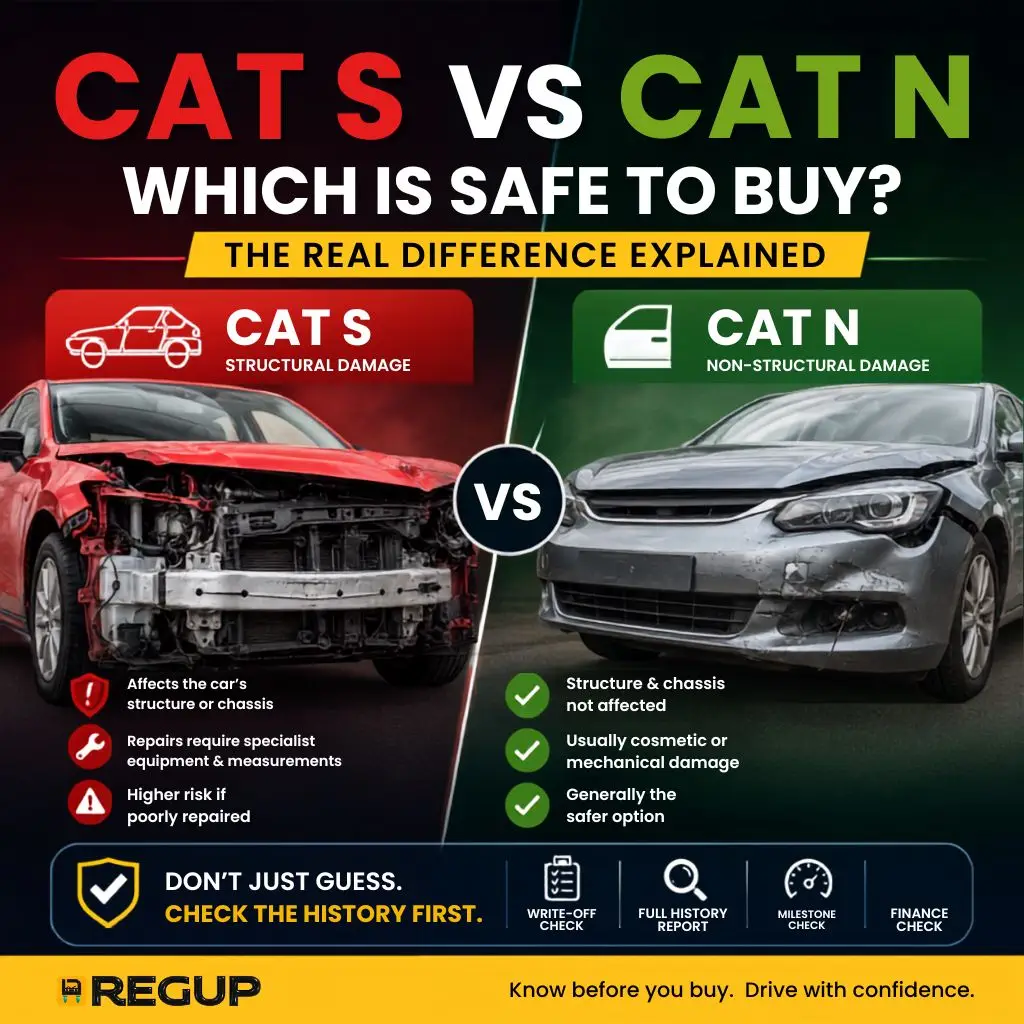
Both are insurance write-offs. Both are repairable. Both can legally return to UK roads. The line between them is structural damage.
Cat S: Structural Damage
The impact reached part of the car's load-bearing structure. Chassis rails, subframe, suspension mounting points, crumple zones, or the pillars around the doors and roof.
These are the parts engineered to absorb and redirect force in a collision. Repairing them properly means jigs, measurement, and welding to manufacturer tolerance. Repairing them badly means the car looks fine and behaves unpredictably when it is hit again.
A Cat S vehicle must be re-registered with DVLA before it goes back on the road.
Cat N: Non-structural Damage
The structure was untouched. Damage was limited to panels, bumpers, lights, glass, interior, electrics or mechanical parts.
Non-structural does not mean minor. A Cat N write-off can involve deployed airbags, a flooded loom, failed ADAS sensors or a seized engine. It became a write-off because the repair bill outgrew the car's value, not because the shell was compromised.
No DVLA re-registration is required for Cat N.
Cat S vs Cat N at a Glance
Cat S | Cat N | |
|---|---|---|
Damage type | Structural | Non-structural |
Areas affected | Chassis, subframe, crumple zones, pillars | Panels, electrics, airbags, mechanical, interior |
Legal to return to road | Yes, once repaired | Yes, once repaired |
DVLA re-registration | Required | Not required |
Typical value reduction | 30% to 40% | 20% to 30% |
Insurance impact | Higher premiums, some insurers decline | Usually covered, premiums can rise |
Marker on history | Permanent | Permanent |
Risk if badly repaired | Crash protection compromised | Safety systems or reliability compromised |
Independent inspection | Essential | Strongly advised |
The pattern is consistent. Cat S carries more downside if the repair was poor, so it discounts harder and insures worse. Cat N carries less structural risk but is not automatically safe.
So Which is Safer to Buy?
Cat N, in most cases. A dented door and a replaced bumper are easy to verify with your own eyes. A repaired chassis rail is not.
But the honest version is more useful than the simple one:
A Cat N car with cosmetic damage and full repair invoices is often a genuinely good buy.
A Cat N car with fire, flood or airbag damage and no paperwork is a worse risk than a well-documented Cat S.
A Cat S car repaired by a manufacturer-approved body shop, with a jig report and an inspection certificate, can be perfectly sound.
A Cat S car with a vague story and no receipts is the one to walk away from.
Evidence beats category. Every time.
Why Cars Get Written Off in the First Place
A write-off is an economic decision, not a verdict on whether a car can be fixed.
Insurers write a car off when the repair cost passes a percentage of its market value. That percentage is why the same damage produces opposite outcomes on different cars. A £3,000 hatchback with £2,200 of damage gets written off. A £30,000 estate with identical damage gets repaired and nobody ever hears about it.
This is also why write-off markers cluster on older, cheaper cars. Around 562,000 vehicles were written off by UK insurers in 2024, and a large share of the repairable ones returned to the market at a discount. Before you assume a cheap car is a bargain, run a free car check on the registration.
What the Categories Were Before 2017
The ABI replaced the old system in October 2017 to describe damage rather than repair cost.
Old category | Modern equivalent | Meaning |
|---|---|---|
Cat A | Cat A | Scrap only. The entire vehicle must be crushed. No parts may be reused. |
Cat B | Cat B | Body shell destroyed. Some parts may be salvaged. Never legal to drive again. |
Cat C | Cat S | Repairable, repair cost exceeded value. Now described as structural. |
Cat D | Cat N | Repairable, lower repair cost. Now described as non-structural. |
Cars written off before October 2017 still carry Cat C or Cat D markers, and they never convert. If you see Cat C, read it as structural. If you see Cat D, read it as non-structural. Cat A and Cat B have not changed, and any car offered to you with either of those markers should not be on the road at all.
What a Cat S or Cat N Car Should Cost
Expect roughly 20% to 30% off market value for Cat N, and 30% to 40% for Cat S. If the discount is smaller than that, the seller is asking you to absorb the marker for free.
Three things people underestimate:
The discount follows the car forever
You inherit the marker and you take the same hit when you sell. Buy at a fair discount or you pay for it twice.
Insurance costs more, and sometimes is refused
Most insurers will cover a repaired Cat N. Fewer will cover Cat S, and premiums are usually higher. Get a real quote on the registration before you agree on a price, not after.
Finance and warranties get harder
Some lenders will not finance a written-off vehicle, and many extended warranties exclude them. Separately, always confirm there is no outstanding finance check owing on the car, because a write-off history and unpaid finance together is the worst combination in the used market.
How to Inspect a Repaired write-off
Take this list with you. It works for both categories, and it is the part most guides skip.
Panel gaps and alignment
Kneel at each corner and sight down the body. Uneven gaps between doors, wings and bonnet suggest the shell moved and was not brought back true.
Paint and overspray
Mismatched shades in daylight, overspray on rubber seals, or a gritty finish along one side all point to panel work the seller has not mentioned.
Fresh underseal or weld marks
Look under the sills and inside the wheel arches. New underseal on an older car often hides repair. Factory welds are neat and evenly spaced. Repair welds rarely are.
Airbag and warning lights
Turn the ignition to position two and watch the dash. Every warning light should illuminate then go out. A light that never illuminates has been disabled, and on the airbag circuit that is a serious finding.
Boot floor and spare wheel well
Lift the carpet. Rear impacts show here first, in ripples, filler or fresh sealant.
Tyre wear and steering
Uneven wear across a tyre suggests geometry that was never reset. On the test drive, find a straight road and briefly loosen your grip. Pulling to one side after structural work is a red flag.
The paperwork
Ask for the repair invoices, the bodyshop name, and photographs before and after. A confident repairer keeps records. A seller who cannot produce any is telling you something.
Questions to Ask the Seller:
Which category is it, and what was actually damaged?
Who carried out the repair, and can I see the invoices?
Do you have photographs from before the work started?
Was it inspected or jig-measured after repair?
Has it passed an MOT since the repair?
Were the airbags replaced, and by whom?
A seller who answers all six clearly is probably fine. A seller who becomes vague on the second question has told you what you need to know.
How to Check a Car's write-off Category Before You Buy
Sellers are not always the ones hiding it. Plenty of private sellers genuinely do not know, because the marker was applied under a previous keeper and never mentioned when they bought it.
Enter the registration and our write-off check returns the recorded category and the date it was applied. The same report covers the checks that matter alongside it: outstanding finance, stolen markers, mileage check records for clocking, and a VIN check to confirm the car in front of you is the car on the paperwork.
Start with a free car check to see the MOT history and mileage at no cost. If the car is still on your shortlist, take the full vehicle history report before you pay a deposit.
It is also worth running a car valuation so you can see what the same model without a marker is worth, and negotiate against a number rather than a feeling.
Final Thoughts
Cat N is the safer starting point. Cat S is not automatically a bad car, but it demands more proof, a bigger discount and an independent inspection before you hand over money.
Either way, do not take the advert's word for it. Enter the registration, run the write-off check, and buy on evidence.
Frequently asked questions
Is Cat N safer than Cat S?
Usually, yes. Cat N damage never reached the structure, so there is less that can go wrong in a future collision. Repair quality still matters more than the category itself.
Can you insure a Cat S or Cat N car?
Most insurers cover a repaired Cat N. Cat S is more restricted, some insurers decline it outright, and premiums are generally higher. Get a quote on the registration before you agree a price.
Does a Cat S or Cat N marker ever disappear?
No. Both are permanent and stay on the vehicle record for the rest of its life, whoever owns it.
How much less is a Cat S car worth?
Typically 30% to 40% below an equivalent car with clean history. Cat N usually sits at 20% to 30% below.
Does a Cat S car need a new MOT?
An MOT confirms roadworthiness on the day, not repair quality. A Cat S car must be re-registered with DVLA, and a fresh MOT is sensible, but neither is proof the structural repair was done to tolerance.
Is it illegal to sell a Cat S or Cat N car without saying so?
A trader must not misrepresent a vehicle, and failing to disclose a write-off marker can breach consumer protection rules. Private sellers are held to a lower standard, which is exactly why you should check the registration yourself rather than rely on the advert.
What about Cat C and Cat D?
They are the pre-2017 equivalents. Cat C maps to Cat S, Cat D maps to Cat N. They still appear on older vehicles and mean the same thing in practice.
Can a Cat S car be written off again?
Yes. And because its value is already reduced, a second write-off takes far less damage to trigger.