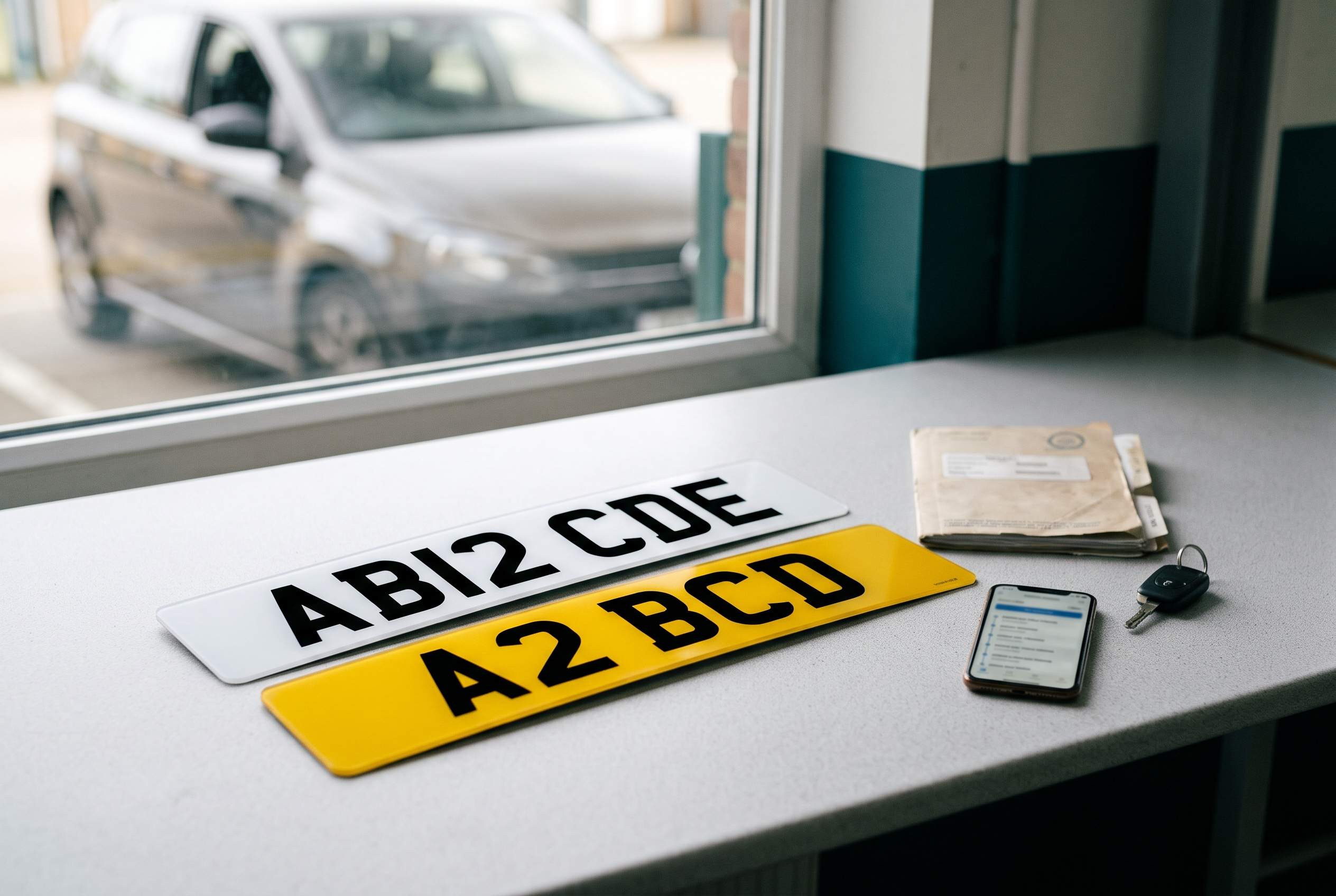
Check the history behind a private plate
Enter the current registration to check recorded plate changes, previous registrations and change dates where supplied.
Paid check. Price shown before payment; records depend on available data.
Key points
- A registration change alone does not establish fraud, accident history or a keeper change.
- Match the physical vehicle identification with the V5C and available records.
- Check the dates and identifiers on older invoices instead of relying only on a registration match.
- Treat an unavailable plate-history field differently from an explicit no-changes result.
- Clarify any private-number retention and updated paperwork before completing the sale.
You are looking at a used car with one registration in the advert and another on its older invoices. The seller says it used to have a private plate. That can be an ordinary explanation, but it still needs to fit the records.
A registration change should prompt a careful identity check, not an automatic verdict that the car is good or bad. Follow the timeline, match the vehicle and resolve gaps before paying.
Does a private number plate hide a car’s history?
Changing a registration does not change what happened to the vehicle. It changes the mark used to identify it on the road. To interpret records across different registrations, you need to establish that those records relate to the same car.
The VIN is central to that check. Compare the identification on the vehicle with its V5C and the available records. GOV.UK’s used-vehicle checks specifically include matching the VIN and engine number with the log book.
Databases can differ in coverage and update timing. Do not assume one search has retrieved every older record, or that a gap proves there is nothing to find. Ask the provider about an unclear result and compare the evidence.
Why might a vehicle have changed registration?
A private registration may be assigned to a car and later retained for use on another vehicle. GOV.UK explains the process for assigning a private number. When a private number is removed, the vehicle’s original registration is usually reassigned automatically.
That can leave a perfectly explainable mix of registrations in the service folder. The important part is the sequence: which mark was assigned when, and whether the other vehicle details agree. A change alone does not establish fraud, an accident or a change of keeper.
Also separate the physical plates from the registration itself. Replacing a cracked plate with another displaying the same mark is not the same as assigning a different registration to the car.
Match the car, the current registration and the paperwork
Start with the current registration supplied by the seller, then check the car in person. Use the manufacturer’s identified VIN locations and seek professional help if the identification appears altered or inconsistent.
| Record or item | What to compare | If something differs |
|---|---|---|
| Vehicle identification | The physical VIN and the V5C details. | Pause the purchase and establish the reason before treating any report as belonging to that car. |
| Current V5C | Registration, make and other vehicle details against the car and advert. | Ask for the current document and an explanation of any recent transfer. |
| Older service invoices | VIN where recorded, vehicle details, dates and mileages. | Trace the earlier registration rather than assuming the invoice is unrelated or genuine. |
| MOT history | Available dates, mileage points and vehicle details. | Investigate gaps or inconsistencies with the seller and relevant record provider. |
DVLA’s VIN guidance explains the official vehicle-identification process. A matching number plate on its own is not a substitute for checking the physical vehicle.
What can a number plate change history check show?
REGUP’s plate-change history check is intended to show recorded changes, previous registration marks and associated dates where the licensed history data supplies them. Use the information to ask better questions about the documents and timeline.
It is not a list of every person who has owned or kept the car. Do not expect the result to supply private individuals’ names or addresses, or treat a registration change as a keeper change.
A plate-history result is also separate from paid checks for finance, stolen markers or write-off history. Review the items included in your chosen report. Selecting one focused check does not mean every paid section has been purchased.
“No changes found” and “not available” are different
Read the status of the supplied result, not just the absence of a long timeline. REGUP’s plate-history page distinguishes an explicitly supplied zero count or empty history from a field the provider has not supplied.
| Result | What it supports | Useful next step |
|---|---|---|
| Recorded changes returned | A timeline to compare with the seller’s explanation and paperwork. | Match the available dates and registrations with the vehicle records. |
| Explicit “no changes found” result | No changes were returned in that supplied history result. | Continue the identity and wider history checks; this is not a whole-car guarantee. |
| “Not available” | The necessary plate-history information was not supplied. | Ask about coverage and use other evidence. Missing information is not a clean result. |
| A recent transfer is still unclear | The current paperwork and data need reconciling. | Confirm the assigned registration and updated documents before agreeing a handover. |
Even an understandable plate timeline does not assess the car’s mechanical condition. Keep the report, paperwork and inspection as separate parts of the decision.
An old registration on an invoice: a worked example
Imagine that an invoice from March 2022 shows AB12 CDE. A later record places a private registration, A2 BCD, on the vehicle in July 2022. An invoice from 2024 uses A2 BCD. This is an illustrative example, not a real REGUP customer history.
The dates could fit a normal change. You would still compare the VIN where shown, the make, the work, the mileage and the rest of the service sequence. Matching registration dates do not authenticate an invoice by themselves.
If the dates do not fit, ask for an explanation and supporting records. A discrepancy can reflect incomplete information or an error, as well as a more serious problem. Establish the facts before either dismissing the evidence or relying on it.
What if the seller wants to keep the private number?
Settle this before the sale is completed. Ask which registration the vehicle will carry at handover and when the updated V5C will be available. Do not build the transaction around an assumption that changing the physical plates completes the DVLA process.
The official retention guidance says the keeper must have the retention document and new V5C before selling the vehicle if retaining the private number. Follow the current DVLA instructions for the actual circumstances.
Use the confirmed current registration for the final vehicle checks and insurance arrangements. If the records are changing close to the sale, allow time to resolve them. A seller’s deadline is not a reason to accept unclear identification or paperwork.
Keep the wider buying checks separate
A plausible registration history is one part of a used-car assessment. It does not answer whether a finance agreement is recorded, whether the vehicle has a stolen marker or whether an insurer has recorded a write-off.
Compare MOT mileage with service records and the odometer, and arrange an inspection appropriate to the car. The Motor Ombudsman’s buying guide recommends checking those records alongside vehicle identification. For a fuller explanation of the identifier itself, read what a VIN number means.
If a report displays a marker or information you do not understand, pause and ask for clarification. Do not treat a green-looking section, a fresh MOT or a private plate as a substitute for that explanation.
Check the timeline before paying
- Confirm the registration that is currently assigned to the car.
- Compare the physical VIN, V5C and available report details.
- Read the plate-change result and investigate unexplained differences.
- Match older paperwork using dates, mileage and vehicle identifiers.
- Choose any further history checks you need and complete the inspection before making the final decision.
Start with REGUP’s plate-change history check for the recorded timeline, or review the full report options for broader checks. You can view a sample report before choosing.
Frequently asked questions
Does changing the number plate erase a car's past?
It does not change what happened to the vehicle. Linking the available records across registrations still depends on correct vehicle identification, provider coverage and update timing.
Is a previous registration on a service invoice a warning sign?
It needs checking, but can have an ordinary explanation after a plate change. Compare dates, VIN where recorded, vehicle details and mileages with the rest of the history.
Does a private plate change mean the car changed keeper?
Not by itself. A registration can be assigned or removed without that establishing a keeper change. Read keeper and registration records as separate information.
What does REGUP's plate-change check include?
Recorded changes, previous registration marks and associated dates where supplied by the licensed history data. Review the selected report items; other paid checks are not automatically included.
What if the plate-history result says not available?
The necessary information was not supplied. Do not interpret that as proof that the car has never changed registration; compare other evidence and ask about coverage.
What if the seller wants to keep the private registration?
Clarify the assigned registration and updated documents before completion. Follow DVLA's current retention process; the official guidance requires the retention document and new V5C before sale when retaining the number.
Sources and further reading
- https://www.gov.uk/checks-when-buying-a-used-car
- https://www.gov.uk/vehicle-registration/vehicle-identification-number
- https://www.gov.uk/personalised-vehicle-registration-numbers/keep-or-assign
- https://www.gov.uk/personalised-vehicle-registration-numbers/take-private-number-off
- https://www.themotorombudsman.org/used-cars-buying-guide/
- https://regup.co.uk/number-plate-change-history-check