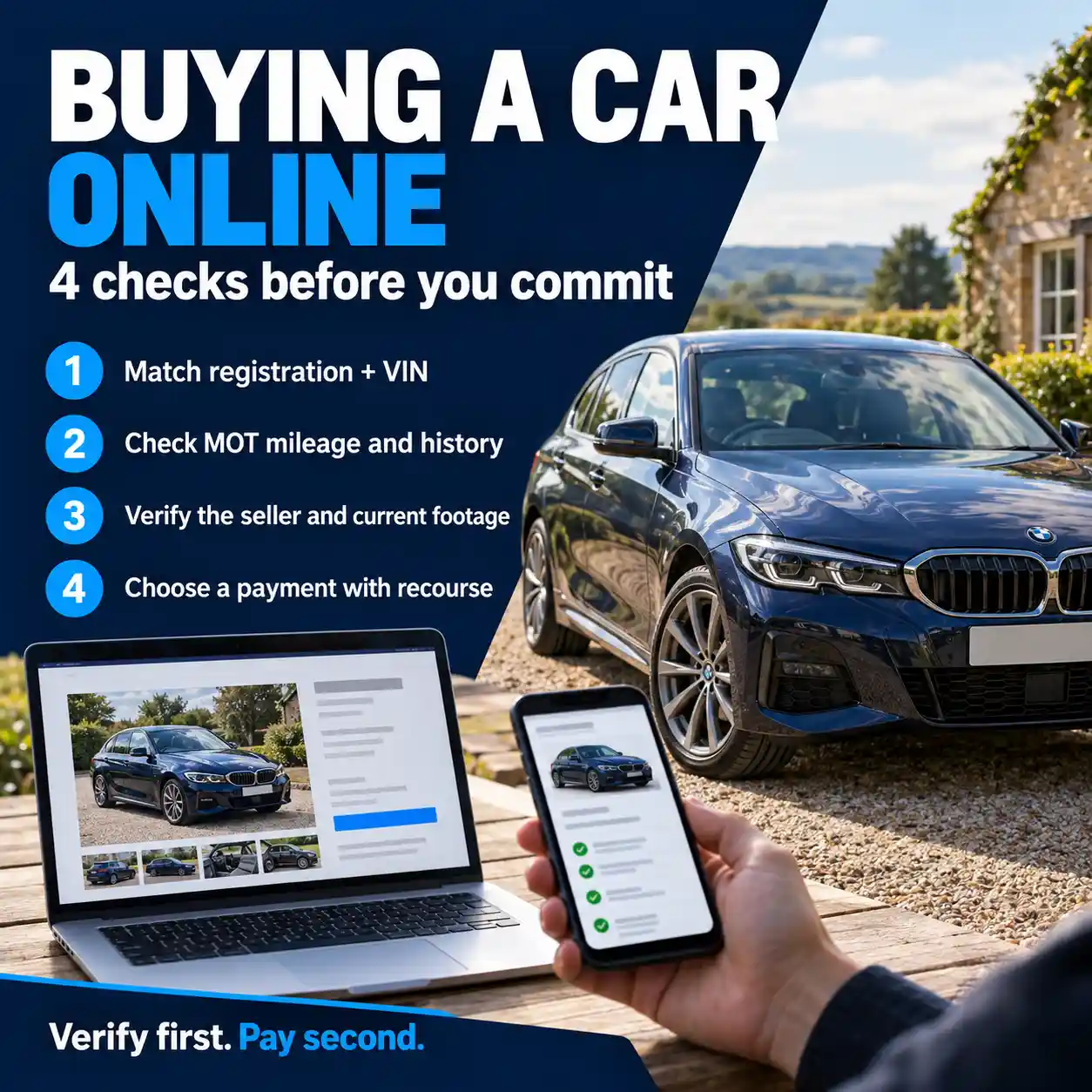
Key points
- Never pay a deposit before you have verified the registration against an independent record.
- No legitimate seller uses a third party escrow or holding account run through a messaging app.
- Buy online from a dealer without visiting the premises and you normally get 14 days to cancel under the Consumer Contracts Regulations 2013.
- A private online sale carries no cancellation right at all.
- A card payment between £100 and £30,000 to a business gives you a claim route that a bank transfer does not.
Online buying moved faster than the safeguards
Most used cars in the UK are now found online, and a growing share are bought without the buyer ever standing next to the vehicle before paying. Delivery to your door, a video walkaround instead of a viewing, and a card payment instead of cash in a driveway.
That convenience removes the step that used to catch problems. When you view a car in person you unconsciously verify a dozen things: the seller exists, the car exists, the address is real, the plates match the paperwork, the VIN matches the plates.
Remove the viewing and every one of those checks has to be done deliberately, using records rather than eyes. This guide is the deliberate version.
It covers two different situations that get confused. Buying remotely from a business, where the law gives you real protection, and buying remotely from a private seller, where it gives you almost none.
Establish that the vehicle exists before anything else
The first job is not assessing the car. It is confirming that the car in the advert is a real vehicle with a real record that matches what you are being told.
Ask for the registration and, ideally, the VIN. A genuine seller provides both without hesitation. Then run them. A number plate check returns the recorded make, model, colour, engine size, fuel type and year, and a VIN check confirms the vehicle identification details.
Compare every returned field against the advert. A silver 1.6 diesel advertised as a 2.0 petrol in black is not a typing error. It is either a copied listing or a cloned vehicle.
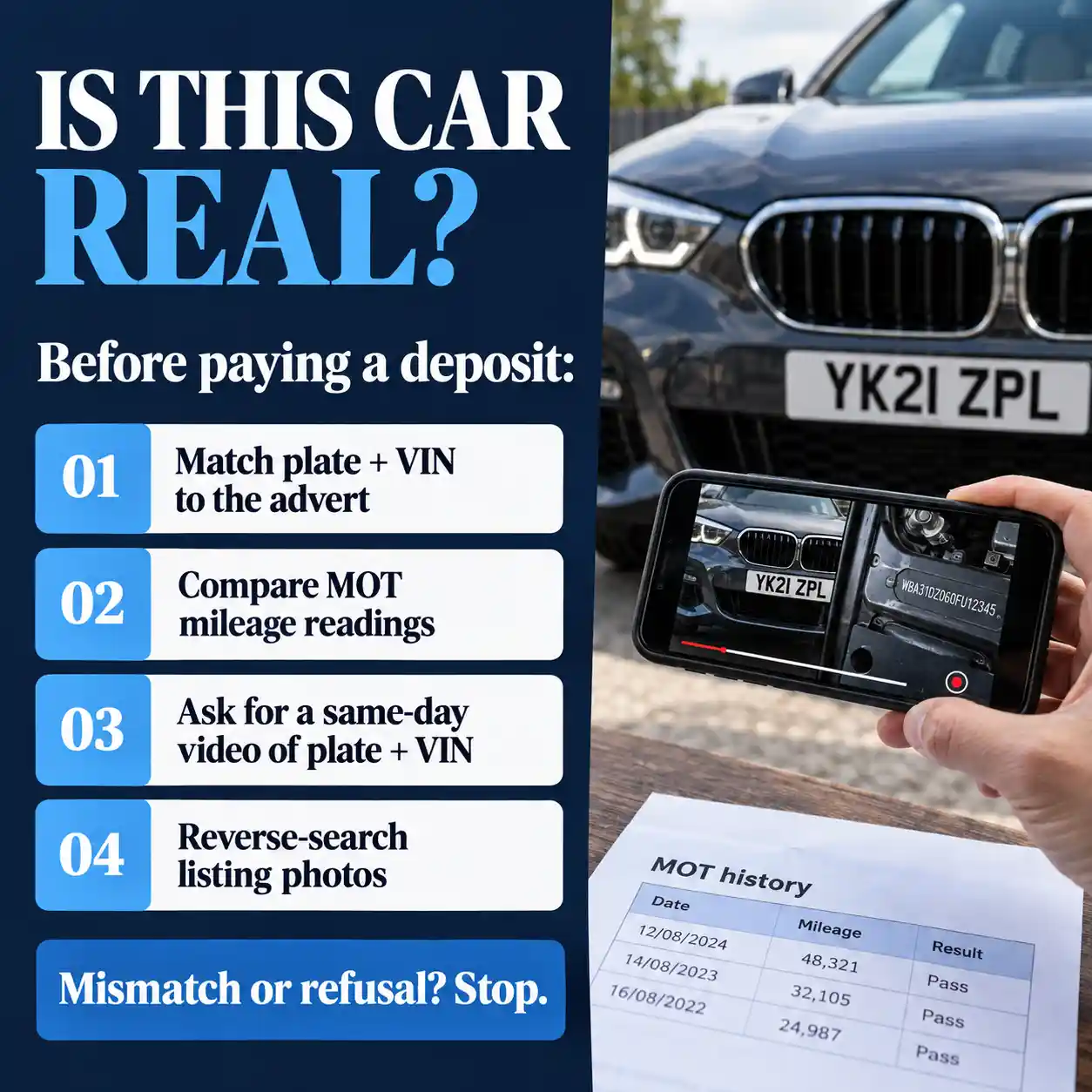
Then check the MOT record for the mileage timeline. If the advert says 62,000 miles and the last recorded test reading was 94,000, the conversation is over. A mileage check gives you the readings, and our guide on what car clocking is explains how the fraud usually presents.
These checks take a few minutes and they are the highest value minutes in an online purchase, because they are the only independent verification available to you before the car arrives.
Ask for evidence that cannot be copied from another listing
Photographs are the easiest thing in the world to steal. Fraudulent adverts are routinely built from images lifted from a genuine listing elsewhere.
The counter is to request something specific and current that could not have been prepared in advance. Ask for a short video walkaround filmed today, with the seller reading out the registration and showing the VIN plate at the base of the windscreen or on the door pillar.
Ask for a photograph of the V5C with the seller's name visible, and check that the name matches the account or business you are dealing with. Ask for a clear image of the odometer with the ignition on.
Run a reverse image search on the main advert photographs. If the same car appears in listings in three different cities, you have found a copied advert rather than a popular model.
If the seller cannot or will not provide current footage, stop there. The cost of stopping is nothing. Our guide on where to find the VIN number on a car shows exactly where to ask them to point the camera.
The scam patterns that recur
Vehicle fraud recycles a small number of structures. Once you recognise the shape, the individual story does not matter.
The fake escrow or holding account. The seller proposes a payment service that supposedly holds your money safely for a cooling off period before releasing it. Action Fraud has warned repeatedly about fraudsters impersonating well known payment brands to run this, including fake versions of services that do not offer escrow at all. No mainstream retailer operates a private vehicle escrow service through email links.
The absent owner. The seller is working abroad, in the forces, relocating, or selling on behalf of a relative. The car is in storage or with a shipping company. Payment is required before viewing. Every element of this story exists to explain why you cannot see the vehicle.
The copied listing. Genuine photographs and details lifted from a real advert, republished at a lower price with different contact details. The price is the bait and the urgency is the pressure.
The deposit trap. A modest, reasonable sounding deposit to "hold" the car, taken by bank transfer, after which the seller becomes harder to reach or the price changes.
The clone. A real, physically present car wearing the identity of another vehicle. This one survives a video call and only fails a records check, because the VIN and the plate will not agree. Read our guidance on how to check if a car is stolen and run a stolen car check before any payment.
The common thread is money moving before verification. Reverse that order and almost all of these fail. Guidance and current alerts are published by Action Fraud.
Pay in a way that leaves you a route back
Payment method is the difference between an expensive mistake and an unrecoverable one.
A bank transfer is the fraudster's preferred method because it is fast and difficult to reverse. Banks operate reimbursement schemes for authorised push payment fraud, but recovery is never guaranteed and the process is slow.
A credit card payment to a business for a purchase between £100 and £30,000 brings section 75 protection, which makes the card provider jointly liable with the seller. Paying even the deposit by credit card can bring the whole transaction within that protection. Debit card payments may qualify for chargeback, which is weaker but still useful.
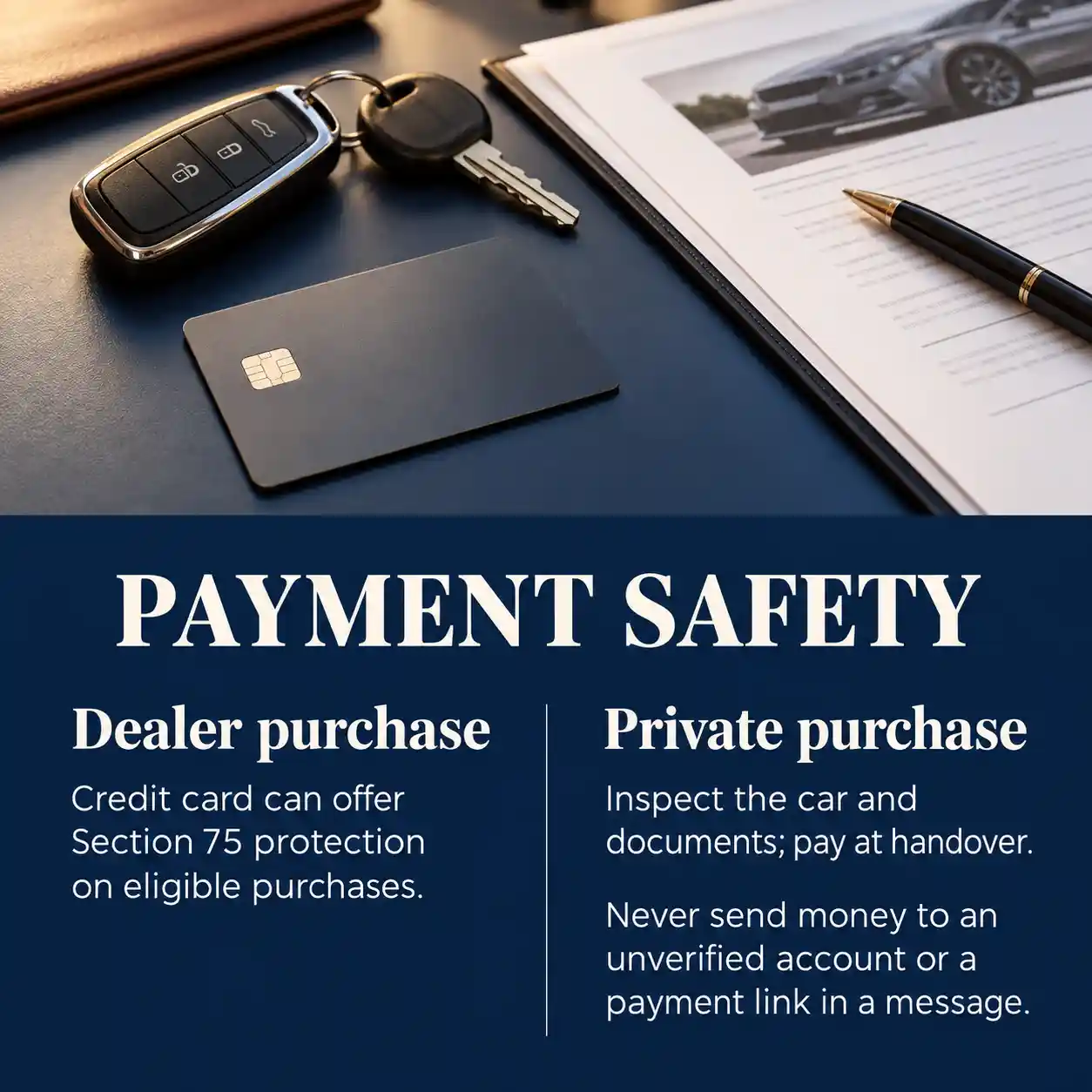
Never pay a private seller in full before the car is in your possession. For a private online purchase, the safest structure is still meeting in person at the seller's home address, verifying the documents, and paying at handover.
Never send money to an account in a different name from the seller or the dealership. Never pay through a link sent by message. And treat any request to switch payment method partway through as a stop signal rather than an inconvenience.
Your rights when buying online from a dealer
This is where an online purchase is genuinely better than a forecourt one.
When a business sells to a consumer at a distance, with no face to face contact, the Consumer Contracts Regulations 2013 apply. You get a 14 day cancellation period that runs from the day you take delivery of the vehicle, and it has nothing to do with whether the car is faulty. You can simply change your mind.
You must tell the seller in writing within those 14 days, and you then normally have a further 14 days to return the vehicle. The seller has 14 days from receiving it back to refund you.
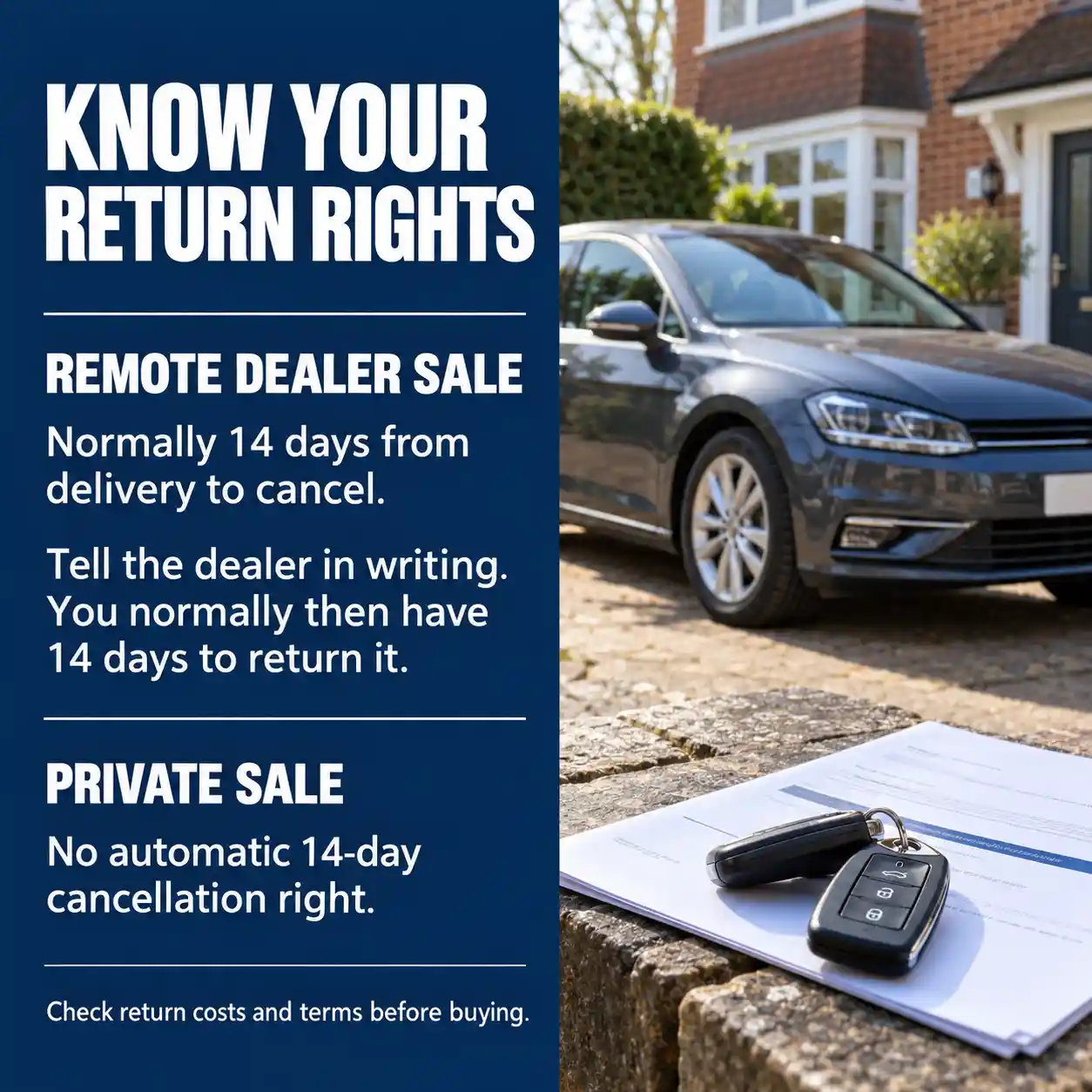
There are limits worth knowing. The dealer can reduce your refund to reflect any diminished value if you have used the car beyond what would be reasonable to inspect it, which in practice means excessive mileage or damage. You may be responsible for the cost of returning the vehicle, so check the terms before you buy.
The cancellation right does not apply if you visited the premises and concluded the sale there, even if you found the car online. It also does not apply to private sales at all.
Separately, the Consumer Rights Act 2015 still applies to the dealer sale on top of this, so a faulty car brings a 30 day right to reject regardless of the cancellation window. Our used car consumer rights guide sets out how the two overlap.
Buying privately online: the same car, none of the protection
A private seller advertising on a marketplace is not covered by either the Consumer Rights Act or the distance selling regulations.
There is no cancellation period. There is no requirement that the car be of satisfactory quality. The seller's obligations are limited to having the right to sell it and describing it accurately.
That does not make private online buying unreasonable. It makes the pre-payment checks non-negotiable, because they are the only protection in the transaction.
Insist on collecting in person from the seller's home address. Verify the V5C against the vehicle and the seller. Confirm there is no outstanding finance and no undisclosed write-off category before you pay. Get a signed receipt, which our car sale documents guide sets out in full.
If a private seller is offering delivery to a stranger before payment clears, or payment before viewing, you are not looking at a normal private sale.
Checking a dealer you have never visited
Online dealers vary enormously, and the good ones are easy to verify.
Look up the company on Companies House and check that the trading name, registered address and company number on the website match a real registered entity with filed accounts. A dealership with a recently incorporated company and no trading history is not automatically fraudulent, but it deserves more scrutiny.
Check whether the dealer is a member of a trade body or an ombudsman scheme, because that gives you an escalation route that does not involve court. Read reviews across more than one platform and look for detail rather than star ratings.
Confirm the physical address exists as a car dealership, not just as an address. Call the landline number and see who answers.
Then check the vehicle itself independently rather than relying on the dealer's own history report. A dealer supplied report is usually genuine, but running your own removes the question entirely. Our blog comparing free and paid car checks explains what each layer covers, and you can see the format in a sample vehicle report.
The buying guides published by Auto Trader are a reasonable second reference on how reputable online retailers operate.
The day the car arrives
Delivery day is your inspection, and it is compressed into a short window with a driver waiting. Prepare for it.
Before the transporter leaves, walk the car in daylight and photograph every panel, the wheels, the interior and the odometer. Note the mileage. Check that the registration and VIN match the paperwork and your report.
Check the documents you were promised are physically present: the V5C or confirmation that it has been applied for, the service history, the MOT certificate, both keys and the locking wheel nut key.
Start the engine from cold if you can, and drive it before the transporter leaves if the terms allow, following our test drive guide. Do not sign a delivery note recording the vehicle as received in good condition until you have actually looked at it. If the driver will not wait, write "not inspected" on the note.
If something is wrong, say so in writing the same day. On a dealer purchase you are inside both the 14 day cancellation window and the 30 day right to reject, and acting immediately preserves both.
For the full purchase process from shortlist to handover, our used car buying guide covers the steps either side of the online part.
Online buying checklist
Get the registration and VIN before discussing price.
Run an independent record check and compare every field against the advert.
Confirm the MOT mileage timeline supports the stated mileage.
Request a same day video walkaround showing the plate and VIN.
Reverse image search the advert photographs.
Verify the seller: Companies House for a dealer, a home address for a private seller.
Confirm no finance, no stolen marker and no undisclosed write-off.
Pay by credit card where the seller is a business, and never by transfer to an unverified account.
Read the return and delivery terms before committing, including who pays for a return.
Inspect and photograph everything on delivery before signing anything.
Frequently asked questions
Is it safe to buy a car online in the UK?
It can be, provided you verify the vehicle against an independent record before paying and use a payment method with recourse. The risk is not the internet, it is paying before verification. Buying from an established dealer at a distance also gives you a 14 day cancellation right that an in person purchase does not.
Can I return a car I bought online?
If you bought from a business without visiting the premises, you normally have 14 days from delivery to cancel under the Consumer Contracts Regulations 2013, with a further 14 days to return the vehicle. The refund can be reduced if the car has been used beyond reasonable inspection. Private online sales carry no cancellation right.
Should I pay a deposit to hold a car I have not seen?
Not by bank transfer, and not before you have verified the registration against an independent record. If you do pay a deposit to a dealer, use a credit card, because that can bring the whole purchase within section 75 protection even when only part of the price was paid on the card.
How do I know an online car advert is genuine?
Ask for the registration and VIN and check them independently. Request a same day video showing the plate and the VIN plate. Reverse image search the photographs. Confirm the seller's identity and address. A genuine seller has no reason to refuse any of these.
What is a fake escrow scam?
A fraudster proposes a payment service that supposedly holds your money until you receive the car, often impersonating a well known brand. The service does not exist, the money goes straight to the fraudster, and the promised cooling off period is invented. No mainstream retailer offers private vehicle escrow through emailed payment links.
Does a vehicle history check matter more when buying online?
Yes. Without a physical viewing, the record check is your only independent verification that the vehicle exists, matches the description, and carries no finance, theft or write-off marker. It does the job that a viewing would otherwise do, and it is the step to complete before any money moves.