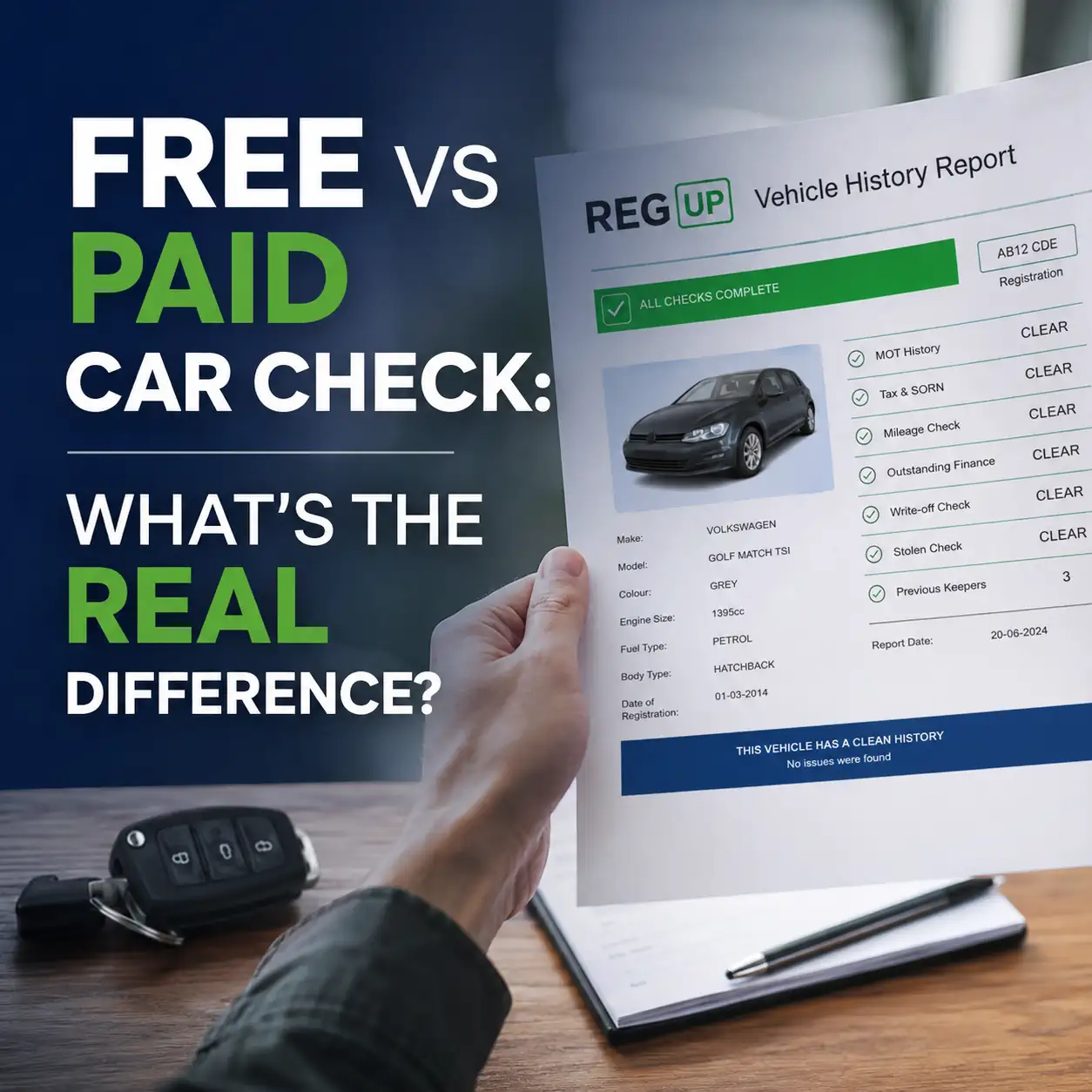
Key points
- Free checks show public record data such as MOT history, tax status and vehicle specification.
- Paid reports add licensed finance and insurance industry data.
- Outstanding finance, write-off, stolen and keeper history are the main paid-report checks.
- Use a free check to shortlist vehicles and a paid report before committing money.
- A paid report does not replace a mechanical inspection.
Free vs Paid Car Check: What You Actually Get
The dividing line is simple once you know it. Free checks show public record data. Paid checks show licensed data. Nothing else really explains the difference.
Public record means DVLA and DVSA information that anyone can look up: MOT history, tax status, vehicle specification. Licensed means data owned by the finance and insurance industries, which providers pay to access: outstanding finance, write-off markers, stolen records, keeper history.
That is why no site anywhere gives you a free finance check. Not because they are holding it back, but because they cannot.
What’s Included in Free vs Paid Car Check?
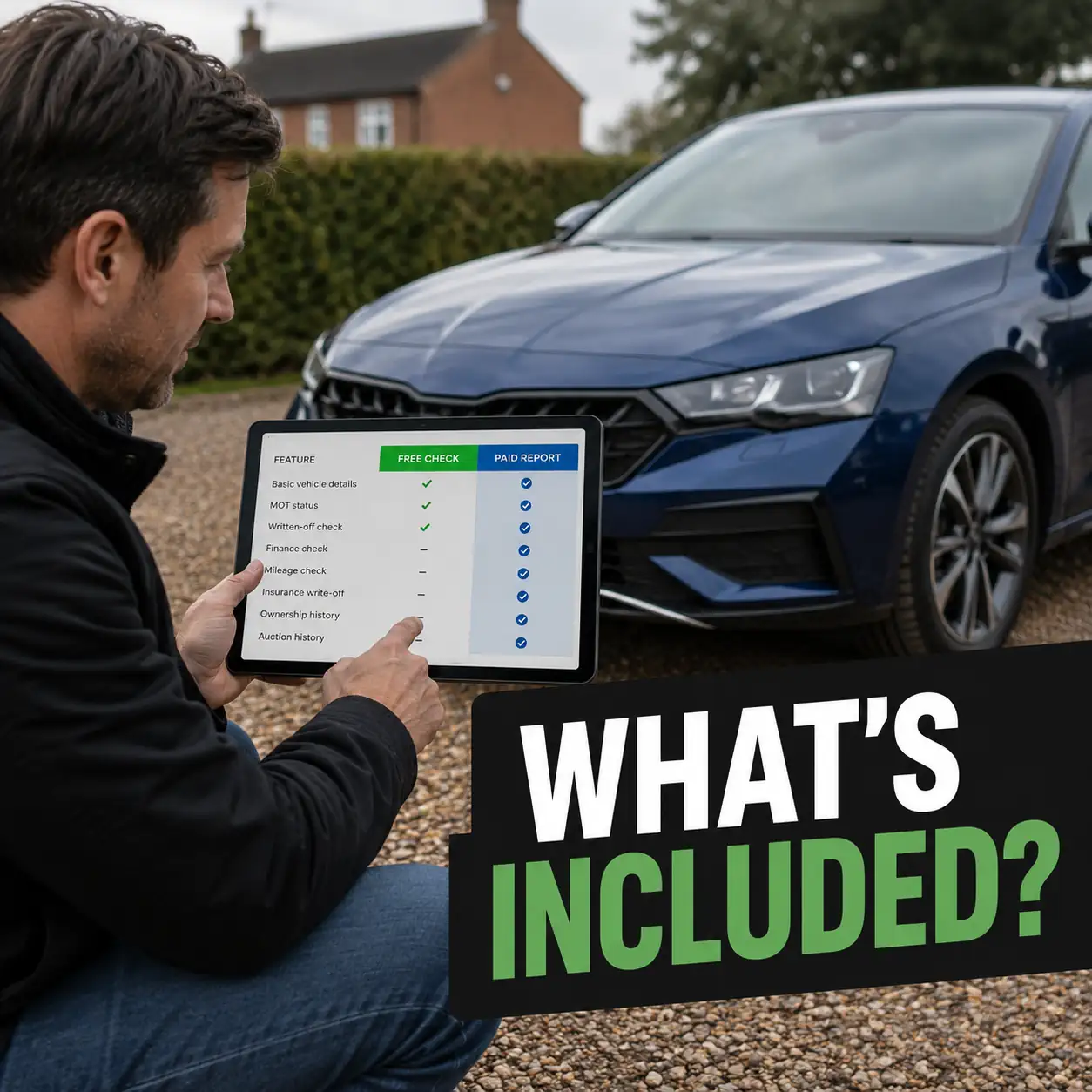
Check | Free | Paid report |
|---|---|---|
Make, model, colour, engine, fuel | Yes | Yes |
Full MOT history with advisories | Yes | Yes |
Mileage recorded at each MOT | Yes | Yes |
Road tax status and expiry | Yes | Yes |
CO2 and Euro emission standard | Yes | Yes |
Outstanding finance | No | Yes |
Insurance write-off category | No | Yes |
Stolen markers | No | Yes |
Number of previous keepers | No | Yes |
Import, export and scrapped markers | No | Yes |
Plate and colour change history | No | Yes |
Verified mileage beyond MOT records | No | Yes |
Current market valuation | No | Yes |
PDF and email delivery | No | Yes |
What the free check is genuinely good for
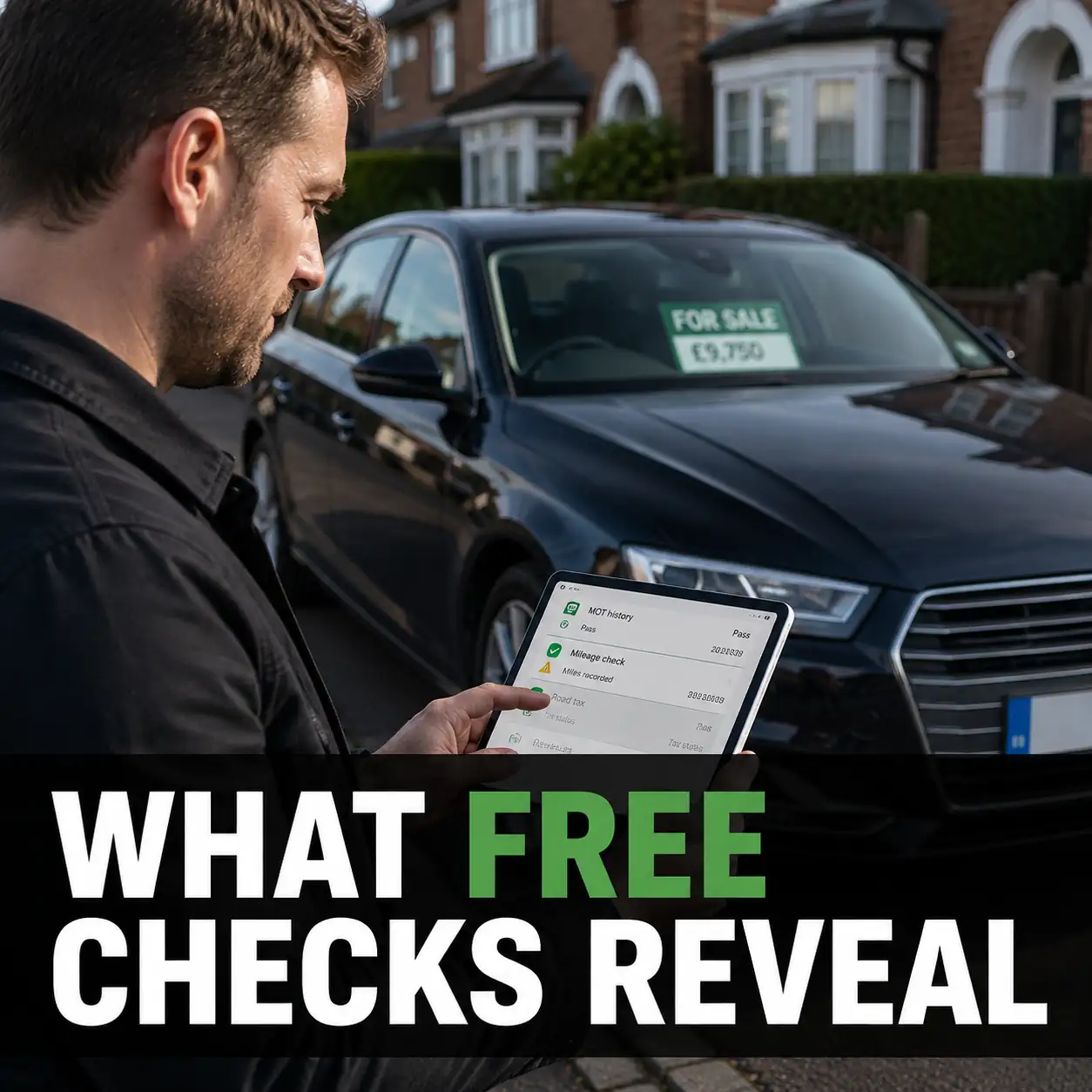
Ruling cars out. That is its job, and it does it well.
Spotting a mileage problem
MOT readings are free and they are recorded in sequence. A reading that drops or barely moves for two years is visible without paying anything. Follow it up with a mileage check if it looks wrong.
Reading the maintenance story
Repeat advisories on the same component tell you what the car will cost you next. The full MOT history is free and most buyers never open it.
Checking the advert is accurate
Make, model, engine size and colour should match the listing exactly. If they do not, you have found either a mistake or a cloned plate.
Confirming it is road legal
Tax status and MOT expiry, both free. The road tax check covers the detail.
Run the free car check on everything on your shortlist. Most bad cars fall out at this stage and it costs nothing.
What only the paid report tells you
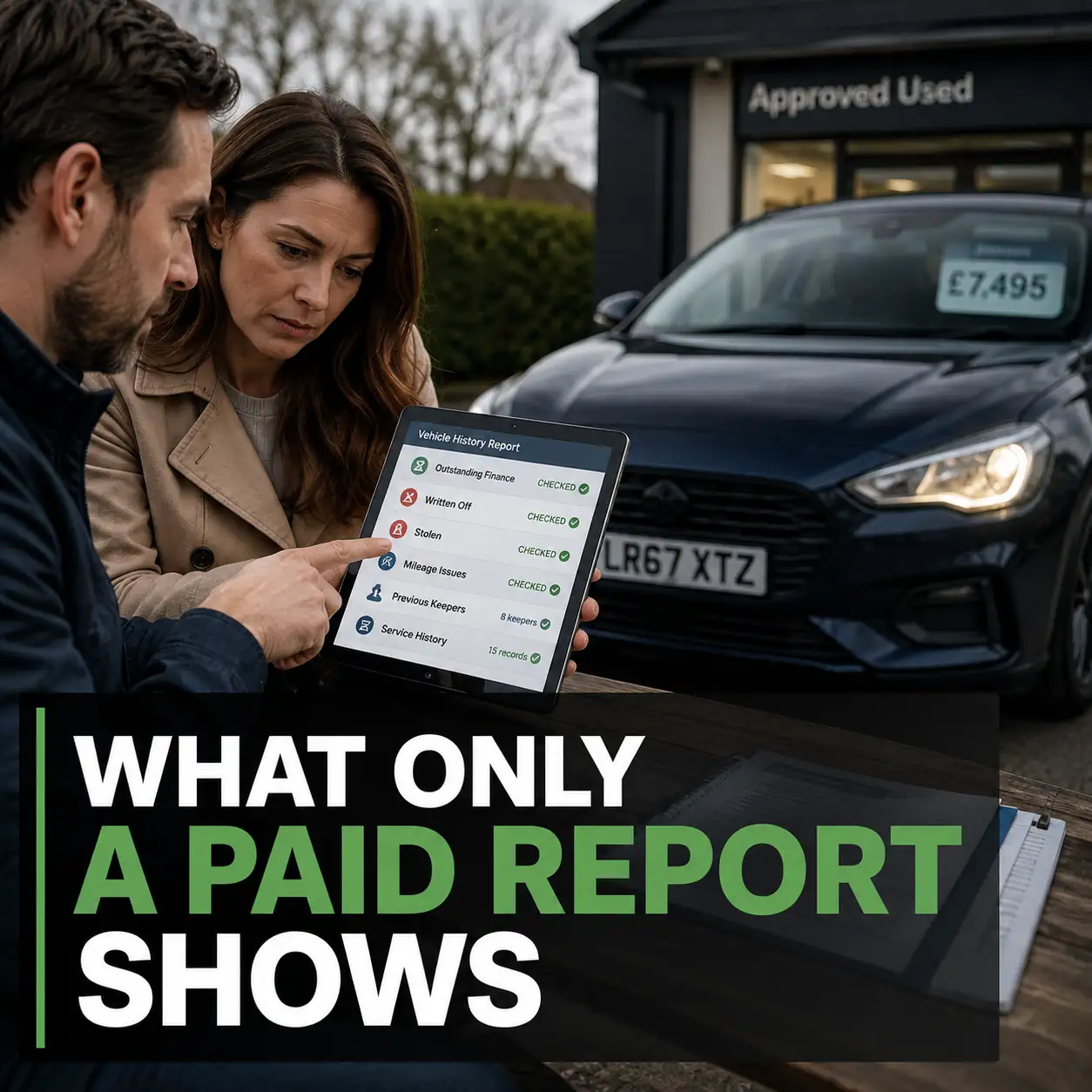
Four things, and they are the four that carry financial risk.
Outstanding finance
The lender owns the car until the agreement is settled and can repossess it from you. This single check is why paid reports exist. See the outstanding finance check.
Write-off history
Cat A, B, S and N markers are permanent, sellers routinely omit them, and they cut a car's value by 20 to 40 percent. See the write-off check.
Stolen markers
Rare, but you lose the car and the money. See the stolen car check.
Ownership history
How many keepers and when it last changed hands, via the previous keeper check. A high count on a young car is a question worth asking.
So which do you need?
Free is enough when
You are shortlisting and want to eliminate obvious problems.
You are checking your own vehicle's MOT or tax dates.
You are buying from a franchised dealer with a warranty and full history.
Pay when
You are buying privately, where consumer protection is minimal.
You are about to pay a deposit or travel a long distance.
The price looks better than it should for the mileage and condition.
Anything in the free check or the paperwork does not line up.
How to avoid overpaying
You should not have to buy a twenty item report to answer one question.
If the free check is clean and you only need finance and write-off confirmation, buy those. Our full vehicle history report lets you build your own, and you can view a sample report before you spend anything so you know exactly what the output looks like.
Be wary of anything advertised as a free full history check. The licensed data behind those claims costs money to access, so either the check is not full or the free part is a teaser that stops at the paywall.
The bottom line
Free checks tell you whether a car is worth pursuing. Paid checks tell you whether it is safe to pay for.
Start with the free car check on every car you are considering, then take a full vehicle history report on the one you are about to buy.