Key points
- Check the millimetre dimensions of the finished plate, not just an inch-size shop label.
- A shorter registration can save width without reducing the space needed for two rows.
- REGUP’s standard motorcycle rear option is currently 228 × 178 mm; the builder shows current availability.
- Measure the mounting area and plan the fixings before ordering.
- A finish choice does not replace a road-use layout check.
A motorcycle plate is often sold by its outside size: 9×7, 8×6 or 7×5 inches. Those labels tell you how big the blank is. They do not tell you whether the registration has been laid out correctly.
Start with the lettering and the space around it, then choose a plate that fits both the registration and the bike. A neat tail tidy is no use if the plate has to be squeezed to fit it.
What size is a standard motorcycle number plate?
“9×7” is a familiar shop description rather than one compulsory outside size for every motorcycle. REGUP’s current standard motorcycle rear option is 228 × 178 mm, approximately 8.98 × 7.01 inches. Check the millimetre dimensions on the option you order; nominal inch labels and finished measurements can differ slightly.
| Size description | Outside dimensions | What it tells you |
|---|---|---|
| 9×7 inches | 228.6 × 177.8 mm, converted exactly | A common size description. The finished layout still needs checking. |
| REGUP standard motorcycle rear | 228 × 178 mm | The actual configured dimensions in REGUP’s catalogue when this guide was prepared. |
| 8×6 inches | 203.2 × 152.4 mm | Too short for the standard modern two-line character layout explained below. |
| 7×5 inches | 177.8 × 127 mm | Also too short for that layout. |
The conversions above use 25.4 mm per inch. They are a size comparison, not a list of products REGUP offers. The builder shows the currently available options.
The measurements that decide whether the layout fits
For the ordinary modern motorcycle layout, DVLA’s INF104 number plate guidance gives these dimensions:
| Part of the layout | Measurement |
|---|---|
| Character height | 64 mm |
| Normal character width, except 1 and I | 44 mm |
| Character stroke | 10 mm |
| Space between neighbouring characters | 10 mm |
| Space between the two lines | 13 mm |
| Minimum edge margins | 11 mm |
Two 64 mm rows, a 13 mm line gap and 11 mm above and below need 163 mm of height. That is an illustrative character-layout calculation; it is not certification of a finished plate.
Are 7×5 and 8×6 motorcycle number plates legal?
For a modern motorcycle using that standard two-line layout, the height calculation answers the question: both blanks are shorter than the space required. A registration with fewer characters can save width, but it does not reduce the height of the two rows.
Be wary of a listing that calls a small blank “legal” without explaining the actual character layout. Ask for the finished dimensions and a layout check for your registration. Choosing smaller letters just to fit a bracket does not solve the problem.
This guide deals with the normal modern layout. An older motorcycle, historic plate or unusual registration can need a separate assessment. Do not use a photograph of a different bike as proof that your proposed plate is suitable.
Why a seven-character registration needs more room
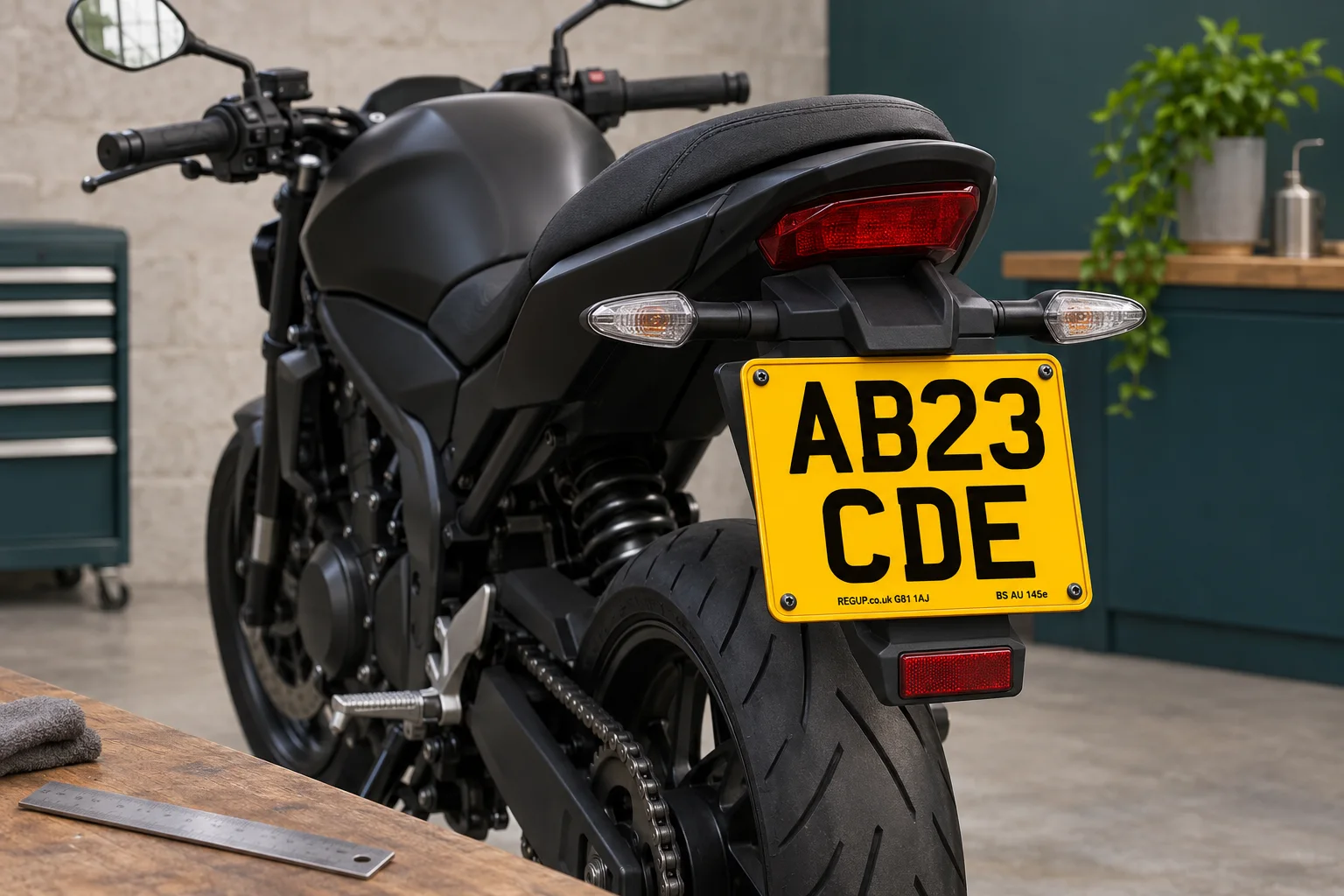
Take an illustrative registration arranged as AB23 on the top line and CDE underneath. Four normal-width characters, their three internal gaps and the two side margins occupy 228 mm across the top.
That helps explain why a familiar near-9-inch blank is useful for a full-length registration. It also explains why a shorter registration and a shorter plate are separate questions. The exact characters, optional details and finished markings all need space.
Send the supplier the complete registration, not just “six digits” or “five digits”. People often use “digits” to mean letters and numbers together, and those descriptions do not give the maker enough information to check a layout.
What about the MOT and road-use markings?
The DVSA motorcycle MOT manual covers the rear plate’s security, condition, readability and layout. A tucked-away plate, an obstructed character or a badly placed fixing can matter as much as the blank’s dimensions.
The manual also tells testers not to inspect the supplier’s name, postcode or BS number. That is a limit on the MOT inspection, not permission to leave required markings off a newly supplied road-use plate. Passing an MOT is not a complete product-compliance certificate.
For the broader display requirements, including the relevant British Standard marking, use GOV.UK’s number plate rules. A decorative show plate is not a substitute for a compliant road-use plate.
Measure the bike before ordering
A few minutes with a ruler can prevent an awkward fitting job:
- Measure the present plate. Note the width and height in millimetres rather than guessing from a seller’s photograph.
- Measure the mounting area. Check the bracket and the position of its fixing points. Include anything sitting immediately above or beside it.
- Make a card template. A 228 × 178 mm piece of card is a useful way to assess the outline without drilling or cutting a plate.
- Look from directly behind. Check whether the plate’s position would leave the registration readable, rather than judging only from a close side view.
- Plan the fixings. Do not assume holes in a replacement will line up with an old plate. Check the maker’s fitting instructions before drilling.
- Keep the finished plate secure. If the bracket or fixing method is uncertain, ask a suitable fitter to check it.
If your bracket cannot accommodate the chosen road-use plate, discuss the bracket with a fitter before ordering a smaller blank. Start with a suitable layout and work out how to mount it.
Does a 3D gel or 4D finish change the size rules?
A finish changes the appearance of the characters; it does not create extra room on the blank. Compare the outer dimensions and registration layout first. Then decide whether you prefer flat printed characters or the appearance of a raised finish.
On a smaller motorcycle plate, a close-up product photo can make raised characters look much larger than they will on the bike. Use the saved measurements, not the camera angle, to judge the fit. For a separate discussion of finishes and their road-use conditions, see REGUP’s guide to 3D and 4D plate legality.
How to order the right motorcycle plate from REGUP
Open REGUP’s motorcycle number plate builder, enter the registration and confirm that you are configuring a motorcycle rear plate. Check the selected size and the complete registration before choosing the finish and any available details.
The standard motorcycle rear option recorded for this guide is 228 × 178 mm. Availability can change, so use the current builder selection and price for your order. Do not select a car plate and rely on the registration being split into a suitable bike layout afterwards.
A replacement physical plate does not assign a private registration to the motorcycle. If you are changing the registration itself, complete the relevant assignment first and follow DVLA’s instructions about when to display it.
A registered supplier needs the required original identity/address and registration-entitlement evidence. Check which documents are needed before ordering, and follow the instructions for your order. An upload is not a reason to assume original-document checks have been waived.
For a broader comparison of car, bike and other blank sizes, use REGUP’s number plate size guide. If you are ready to choose your bike plate, build your motorcycle number plate and check the current quote.
Official guidance and REGUP catalogue dimensions checked on 7 November 2026. Product illustrations are illustrative and are not a scale drawing or evidence of a finished plate’s compliance.
Frequently asked questions
Is 9×7 the only legal motorcycle plate size?
No. The outside label alone does not decide compliance. The finished plate must accommodate the applicable registration layout and meet the other road-use requirements.
Can I use a 7×5 motorcycle number plate on a modern bike?
Not for the standard modern two-line character layout described here: the blank is too short for it. Ask the supplier to assess any different age-specific arrangement rather than shrinking the lettering.
Does having fewer characters make an 8×6 plate suitable?
Fewer characters can save width, but the standard two-line layout still needs its height. Confirm the complete specification before buying a smaller blank.
Can I put a motorcycle registration on one line?
The normal modern motorcycle rear plate uses two lines. Choose a motorcycle layout rather than treating a single-line car plate as an alternative.
What motorcycle plate size does REGUP currently list?
The standard motorcycle rear option recorded for this guide is 228 × 178 mm. Check the live builder for the current size, finish choices and price.
Does a replacement plate come with a new registration?
No. You are ordering a physical plate displaying a registration you are entitled to use. A private registration needs the appropriate assignment before it is displayed.
Sources and further reading
- https://assets.publishing.service.gov.uk/media/6694e379fc8e12ac3edafc60/inf104-vehicle-registration-numbers-and-number-plates.pdf
- https://www.gov.uk/guidance/mot-inspection-manual-for-motorcycles/0-identification-of-the-vehicle
- https://www.gov.uk/displaying-number-plates/rules-number-plates
- https://www.gov.uk/displaying-number-plates/getting-number-plates-made-up