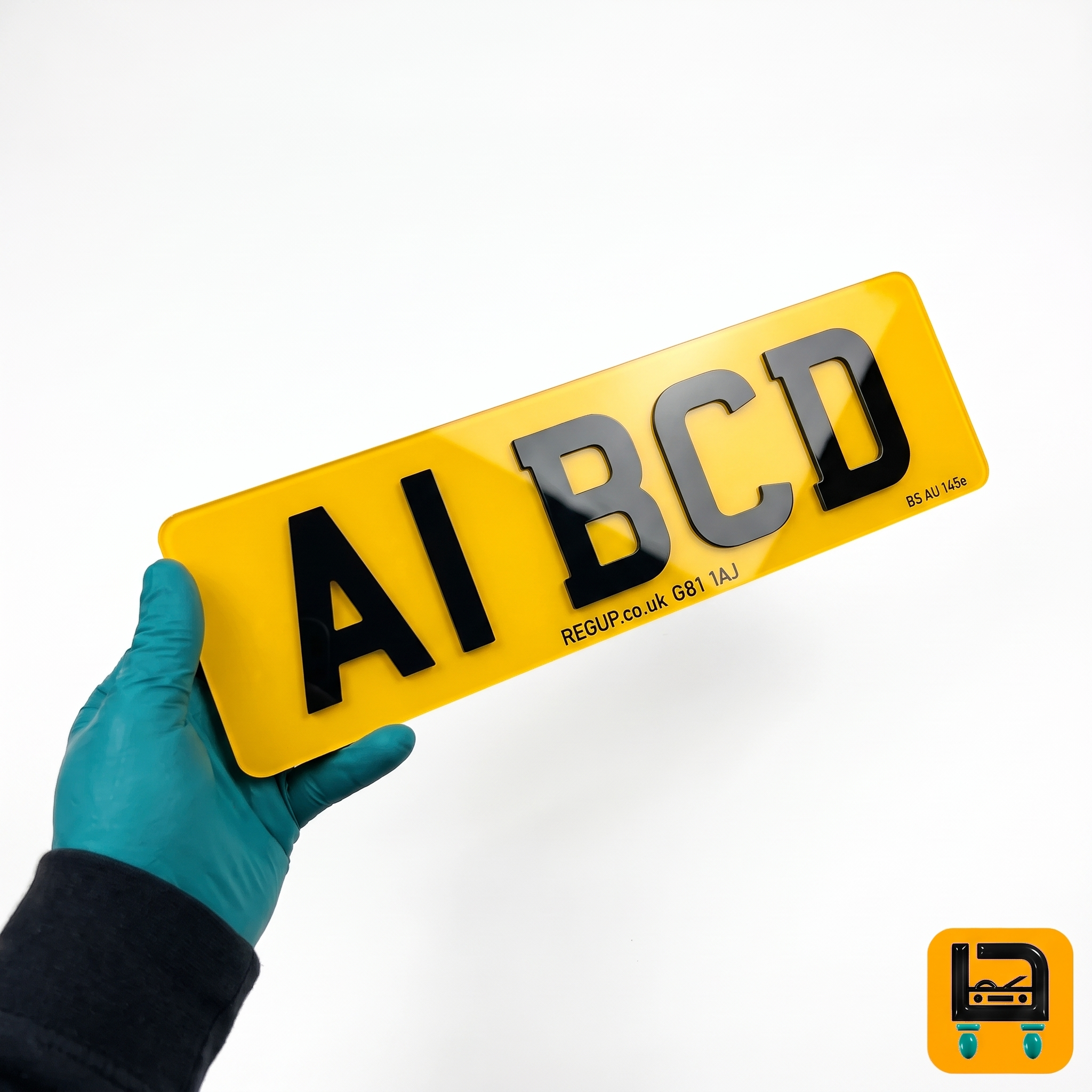
Key points
- Shortening a blank does not permit compressed characters or altered registration spacing.
- Give the supplier the complete registration rather than only its character count.
- REGUP’s current short car blank is 470 × 111 mm; the listed standard option is 520 × 111 mm.
- The example width calculations are not additional products or finished-plate approvals.
- Check the recess, old fixing points and mounting method before choosing a shorter plate.
A shorter plate can tidy up the look of a car, particularly when a private registration leaves a lot of unused space. The important question is what gets smaller: the blank can be shorter, but the registration still needs the correct characters, gaps and margins.
Before ordering, separate three decisions: whether the registration fits, whether the blank fits the car, and whether the finished specification is suitable for road use. Getting one of those right does not automatically settle the other two.
Are short number plates legal in the UK?
A shorter outside blank can be used when the complete finished plate meets the applicable requirements. “Short” is not a separate legal lettering style. It does not let a maker compress the registration, remove the proper group spacing or omit required markings.
The DVSA car MOT manual explains the requirements for character layout and spacing. A personalised registration must still be displayed in its proper format. Making the blank shorter is different from moving letters to make a name or word.
For the general display conditions, including reflective backgrounds and the appropriate British Standard marking, see GOV.UK’s number plate rules. A seller’s “show plate” description does not provide road-use approval.
What size is REGUP’s short number plate?
REGUP’s catalogue currently lists its short car front and rear blanks at 470 × 111 mm. The standard car front and rear option is 520 × 111 mm. The short option therefore removes 50 mm from the overall width, while retaining the same listed height.
| REGUP car option | Dimensions | Approximate inches |
|---|---|---|
| Standard front or rear | 520 × 111 mm | 20.47 × 4.37 inches |
| Short front or rear | 470 × 111 mm | 18.50 × 4.37 inches |
These are configured blank sizes, not a promise that every registration and optional detail fits every combination. Check the current choices in the short number plate builder. Smaller dimensions mentioned elsewhere in this guide are layout examples, not extra REGUP products.
How much room does a registration need?
For the usual modern single-line car layout, the normal character size is 79 mm high and 50 mm wide, with a 14 mm stroke. The usual character gap is 11 mm, the group gap is 33 mm and minimum edge margins are 11 mm. The digit 1 and letter I are width exceptions.
The measurements come from regulation 14 and Schedule 3 of the Road Vehicles (Display of Registration Marks) Regulations. Different vehicle classes and older layouts need their own assessment.
The following arithmetic illustrates the space taken by three example registrations using normal-width characters and no side badge. It includes two side margins, but is not a complete specification for manufacturing a plate.
| Example layout | Character-layout width calculation | Result |
|---|---|---|
| A2 BCD — five characters | 250 + 33 + 33 + 22 mm | 338 mm |
| A23 BCD — six characters | 300 + 44 + 33 + 22 mm | 399 mm |
| AB23 CDE — seven characters | 350 + 55 + 33 + 22 mm | 460 mm |
The terms in each calculation are character widths, internal gaps, the group gap and side margins. Required markings, optional details and manufacturing tolerances still need consideration. Ask the supplier to assess the finished layout rather than treating one of these totals as an order size.
Can five-, six- and seven-character registrations use short plates?
A shorter registration often leaves more spare room, which is why short plates are commonly considered for private registrations. But “five-digit plate” is not enough information for a maker. Give the exact letters and numbers.
Seven characters do not automatically rule out a blank that is shorter than a standard 520 mm plate. In the illustrative example above, the character layout occupies 460 mm before other design considerations. That explains why a 470 mm short option and some seven-character layouts are not inherently contradictory. It is still the supplier’s job to check your actual configuration.
The appearance matters too. A five-character registration will leave a different amount of clear space on the same 470 mm blank than a seven-character registration. Look at the selected size and layout together in the builder, rather than assuming every short plate will look tightly cropped around the lettering.
Keep the registration’s proper spacing
A compact blank cannot be used as a reason to close the gap between groups. For an example such as AB23 CDE, keep that grouping; do not move a character across the gap to imitate a different word or registration.
For the wider spacing rules and examples, see REGUP’s number plate spacing guide. If a proposed combination needs squeezed lettering or altered grouping, choose another suitable size instead.
A border or side identifier also occupies part of the available design area. Check the complete selection, not a plain blank with the optional details mentally added afterwards. A style preview is useful for deciding what you like; the final road-use layout still needs the maker’s check.
Will the shorter blank fit the car?
Check the mounting area before paying. Reducing the width by 50 mm does not move existing holes, change the shape of a recess or make marks under the old plate disappear.
- Measure the recess. Look at both its available space and how a shorter outline would sit within it.
- Check the old fixing points. Work out whether the replacement will cover them and how the new plate will be secured.
- Try a paper or card template. A 470 × 111 mm outline is a practical way to judge REGUP’s current short option before making a fitting decision.
- Check front and rear separately. The same car may have different mounting arrangements at each end.
- Plan for the finish underneath. Removing an old holder may reveal marks you would prefer a standard-size plate to cover.
If the standard plate fills a large recess neatly, keeping it may look better than leaving a small blank in the middle. Choose the size that works on your car, rather than the smallest outline you can find.
Should you cut down an existing plate?
Do not assume trimming an existing plate produces the same result as ordering a properly specified short blank. You could remove room needed around the characters or cut through the supplier and standard markings. The remaining plate also has to be suitable as a finished product, not merely look acceptable from a distance.
Ask the original maker before altering a plate. If the goal is a different outside size, a new blank made for that layout is easier to specify and inspect. Keep any fitting work separate from changes to the registration itself.
Ordering a short road-use plate from REGUP
- Open the short number plate page and enter the registration exactly as assigned.
- Choose a front plate, rear plate or pair, then check the selected outside dimensions.
- Compare the finish and any available optional details on that layout. Do not assume a badge or border fits just because the plain version does.
- Review the current quote, delivery selection and order details before payment.
- Follow the order’s document instructions. Production of road-use plates depends on the required approval checks.
You need the required original identity/address evidence and proof that you may use the registration. The official document list explains the accepted evidence. REGUP’s document guide is a useful starting point before you order.
Buying a physical plate does not buy or transfer the registration mark. A private registration must be assigned through the appropriate process before it is displayed on the vehicle.
To compare other blank shapes, read UK number plate sizes and dimensions. To check a short configuration for your car, open the REGUP builder and compare the available options.
Official guidance and REGUP catalogue dimensions checked on 7 November 2026. Width calculations are illustrative and do not certify a finished plate. Product artwork is illustrative, not a scale drawing.
Frequently asked questions
Are short number plates automatically illegal?
No. A shorter blank can be used if the complete finished plate meets the applicable requirements. The label ‘short’ does not allow smaller lettering or incorrect spacing.
Can a seven-character registration fit a short plate?
It can fit some shorter blanks, depending on the actual characters and complete design. Ask the supplier to check the selected configuration; seven characters alone do not establish the required outside width.
Does REGUP offer every minimum width in the examples?
No. The figures explain character-layout space. REGUP’s configured short car option recorded for this guide is 470 × 111 mm; use the builder for the sizes currently offered.
Can I remove the gap to make my private registration fit?
No. Keep the registration’s prescribed grouping and spacing. Choose a suitable blank rather than changing the way the registration is displayed.
Can I shorten my current plate with a saw?
Do not assume trimming preserves a suitable finished plate. It can remove necessary margins or markings. Speak to the maker before altering an existing plate.
Must I use the same outside size at the front and rear?
Check the available options and both mounting areas separately. Each finished road-use plate needs to meet its requirements; the size that suits one end of the car may not suit the other.
Sources and further reading
- https://www.legislation.gov.uk/uksi/2001/561
- https://www.gov.uk/guidance/mot-inspection-manual-for-private-passenger-and-light-commercial-vehicles/0-identification-of-the-vehicle
- https://www.gov.uk/displaying-number-plates/rules-number-plates
- https://www.gov.uk/displaying-number-plates/getting-number-plates-made-up