Key points
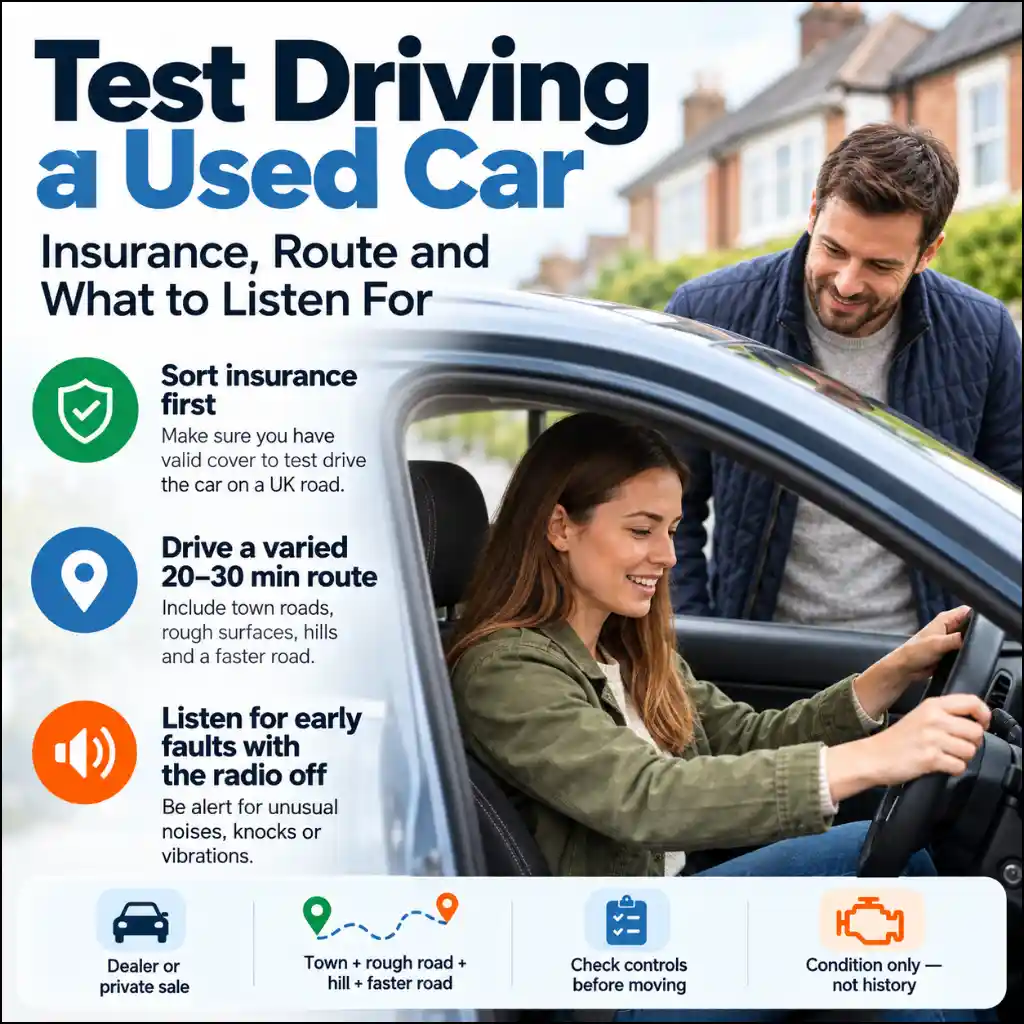
- Driving a car you do not own without valid insurance is an offence regardless of what the seller says.
- A "driving other cars" extension is not universal, is usually third party only, and often excludes cars you are buying.
- Dealers normally carry their own cover, but confirm the age limits and exclusions before you set off.
- A test drive reveals condition. It cannot reveal finance, theft, write-off history or clocked mileage.
- Drive with the radio off for part of the route. Most early faults announce themselves as a sound.
Insurance comes before everything else
There is no version of this where you skip it. Every car driven on a UK road must be insured for the person driving it, and a test drive is not an exception. The seller's policy covers the seller, not you.
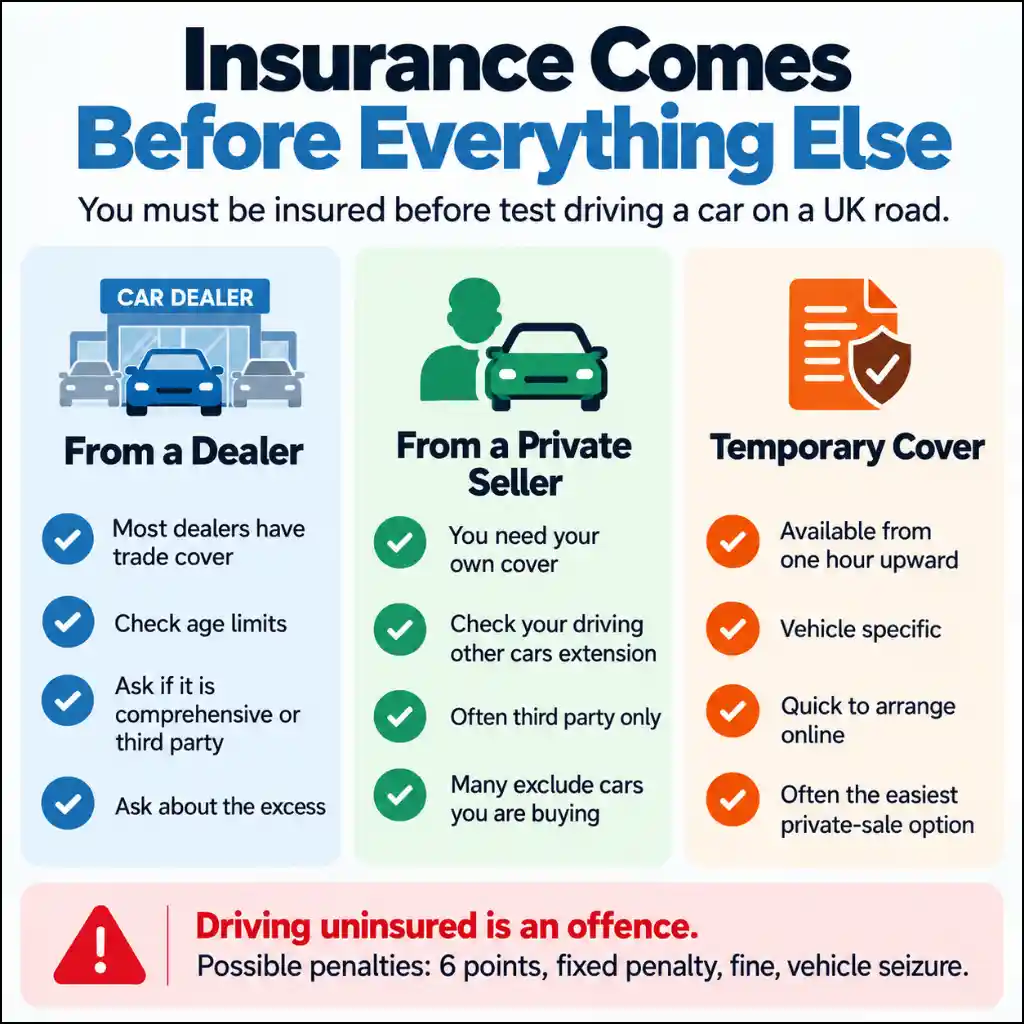
Driving uninsured carries a minimum of six penalty points, a fixed penalty, and the possibility of a court appearance with an unlimited fine, a ban and seizure of the vehicle. That outcome does not change because you were only going to be ten minutes.
Your options depend on who you are buying from.
- From a dealer. Most established dealers hold a motor trade policy that covers test drivers. Confirm it before you arrive, and ask three specific questions: does the cover apply to my age, is it comprehensive or third party, and is there an excess I would be liable for if something happened? Some policies exclude drivers under 25 or those with recent convictions.
- From a private seller. You are responsible for arranging your own cover. Check whether your comprehensive policy includes a "driving other cars" extension, then read the conditions rather than assuming. These extensions are commonly third party only, often restricted to drivers over 25, and many explicitly exclude vehicles you are in the process of buying. Third party only cover also means any damage to the car you are driving is your bill.
- Temporary cover. Short term policies are widely available from one hour upwards and can be arranged in minutes on a specific registration. If you are viewing a private sale, this is usually the cleanest answer. Note that the cover is vehicle specific, so viewing three cars in a day needs three policies.
Whatever route you take, confirm the cover is live before you get in. The guidance published by the Association of British Insurers is a useful neutral reference on what motor policies typically include.
What to do before you move
The first five minutes should happen with the car stationary, and they matter more than people expect.
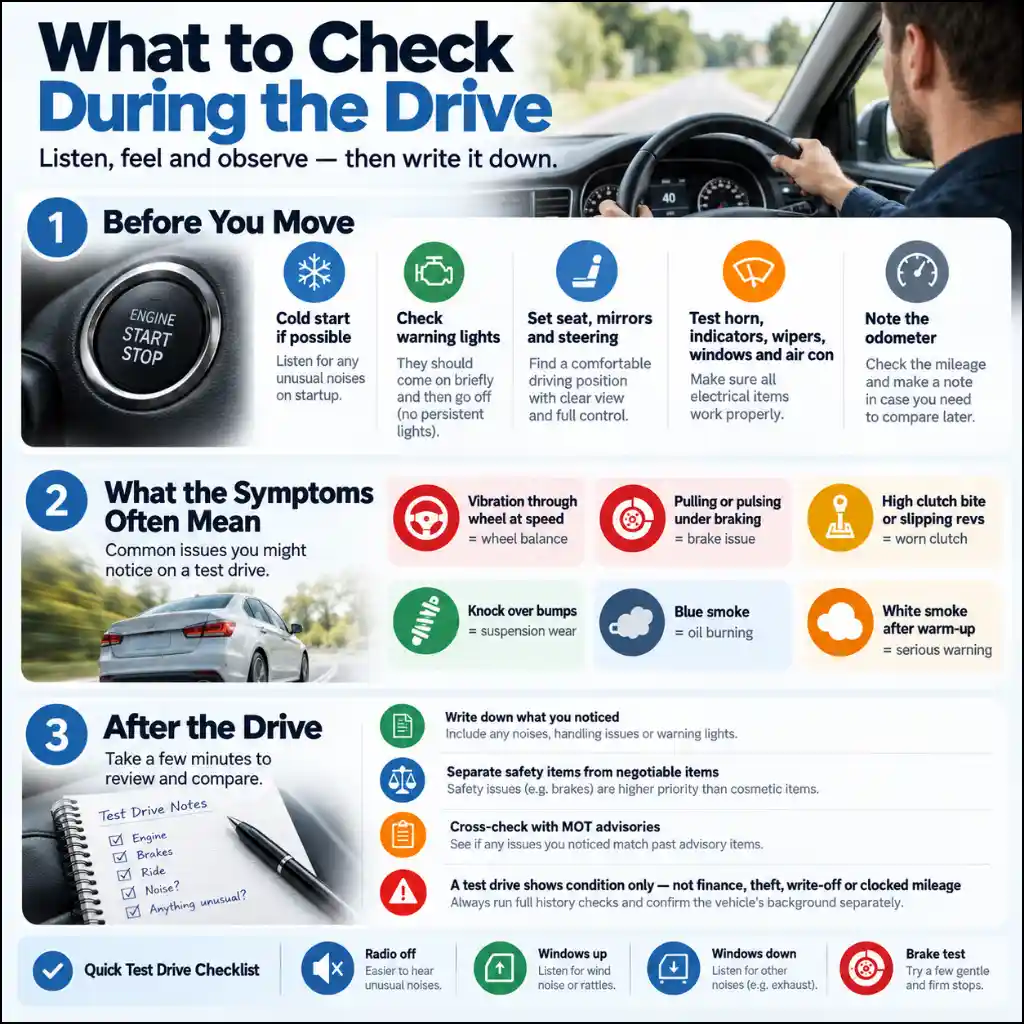
Arrive with the engine cold, and say so when you arrange the viewing. A seller who has warmed the car up has removed your chance to hear a cold start, which is when worn components are loudest and when smoke from the exhaust is most visible.
Start it yourself. Listen to the starter, the first few seconds of idle, and whether any warning lights extinguish properly. A light that stays on, or one that has clearly been removed from the cluster, is a conversation.
Set the driving position properly before you move. Seat, mirrors, steering wheel. Check that the seat adjusts through its full range and that the steering adjusts and locks. A seat that will not hold position is a real fault and an expensive one on some models.
Then check the basics you will rely on: horn, indicators, wipers and washers, lights, heating and air conditioning, electric windows, and the infotainment screen. These are cheap to test and irritating to discover later.
Finally, note the odometer reading. You will want it for the receipt and to compare against your mileage check.
The route: 30 minutes across five surfaces
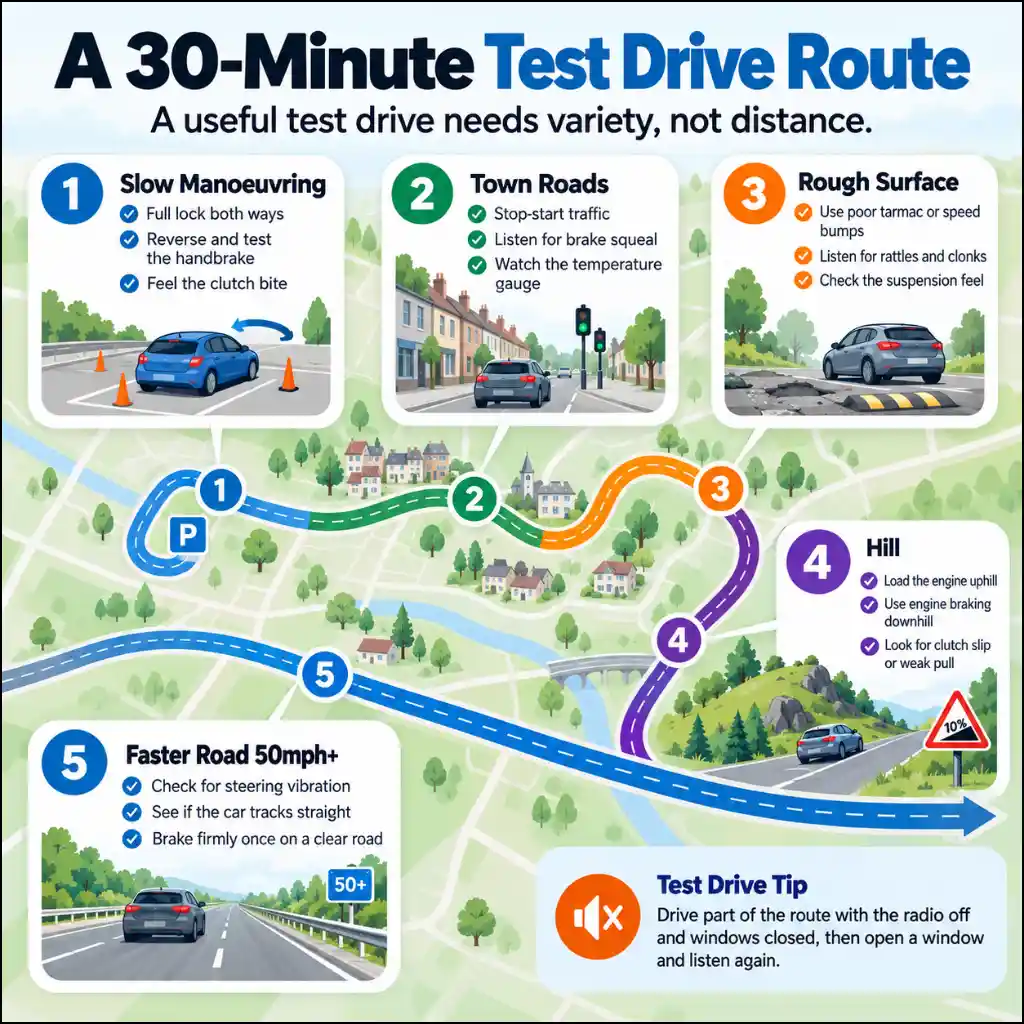
A useful test drive needs variety, not distance. Plan the route before you arrive using a map, and tell the seller what you intend to do.
- Slow manoeuvring, five minutes. Full lock in both directions in a car park or quiet road. Listen for knocking, clicking or groaning from the steering and the front driveshafts. Reverse, use the handbrake on a slope, and feel the clutch bite point if it is a manual.
- Town roads, ten minutes. Stop start driving reveals clutch judder, gearbox hesitation, brake squeal and suspension noise over drain covers. Watch the temperature gauge come up to normal and stay there.
- A rough or uneven surface, five minutes. Poor tarmac and speed bumps expose worn bushes, tired dampers and loose trim. Rattles from the rear on a hatchback are usually trim. Clonks from the front over bumps usually are not.
- A hill, five minutes. Load the engine going up and use engine braking coming down. A struggling turbo, a slipping clutch or a gearbox that hunts between ratios shows up under load in a way it never does on the flat.
- A faster road, ten minutes. Get to 50mph or more if it is safe and legal. Feel for vibration through the wheel or the seat, and check whether the car tracks straight when you briefly ease your grip. Brake firmly once, from a moderate speed, on a clear road, and note whether the car stops in a straight line without pulsing.
For part of the drive, switch off the radio, close the windows and listen. For another part, open a window and listen again. Wind noise, tyre roar and exhaust blow all present differently.
What you are actually testing for
Symptoms are easier to act on than a general impression, so know what each sensation usually means.
A steering wheel that vibrates at speed is commonly wheel balance, which is cheap. A vibration through the whole car under braking is more likely to be warped discs. A pull to one side under braking suggests a sticking caliper.
Clutch bite very high in the pedal travel, or engine revs rising without matching acceleration, points to a worn clutch. That is a significant bill on most cars and a very large one on a dual clutch automatic.
A knock over bumps from the front usually means suspension bushes, drop links or top mounts. Individually these are not expensive, but they often arrive together.
Blue smoke on start up suggests oil burning. Black smoke under acceleration suggests a fuelling problem. White smoke that persists once the engine is warm, rather than clearing after a minute, is the one to take seriously.
A gearbox that is notchy when cold and smooth when warm is usually normal for an older manual. One that crunches into second every time is not.
Automatic transmissions should change gear without a thump and without hunting between ratios at steady speed. Test kickdown once at a safe moment.
None of this requires mechanical training. It requires paying attention with the radio off, and being willing to say that something did not feel right.
What a test drive cannot tell you
This is the part that catches out otherwise careful buyers. A car can drive beautifully and still be a bad purchase.
A test drive cannot show you outstanding finance. The vehicle can feel perfect and still be legally owned by a finance company that can recover it from you. Run a car finance check.
It cannot show you a stolen marker. Cloned vehicles are prepared to look and drive normally. Run a stolen car check.
It cannot reliably show you a repaired write-off. Good bodywork hides structural repair, and category markers only exist on the record. Run a write-off check and read our comparison of Cat S and Cat N vehicles.
It cannot show you clocked mileage. A car with 160,000 miles displaying 78,000 drives like a car, not like a warning. The MOT reading timeline is what exposes it, and our guide on mileage discrepancies explains how to read it.
It cannot show you MOT history, previous keeper count or specification discrepancies. Those come from a free car check and, for the licensed data, a full report.
The sequence that works is records first, then drive. Running the checks before you travel means the test drive is about condition rather than provenance, which is the only question a drive can actually answer. Our used car buying guide sets out the full order.
Test driving etiquette and safety
Private sellers are letting a stranger drive a valuable asset, and buyers are getting into a car with a stranger. Reasonable behaviour on both sides makes this easier.
Bring your driving licence and show it. Expect the seller to photograph it, and expect them to come with you. Both are normal.
Tell someone where you are going and share your location if you are viewing alone. Meet at the seller's home address, in daylight, rather than a car park or a lay-by. If the location keeps changing, reconsider the viewing entirely.
Drive the car as you would drive your own. Testing acceleration and braking properly is legitimate. Driving aggressively on someone else's insurance is not, and it damages your negotiating position more than it helps.
If the seller refuses a test drive outright, ask why. Insurance concerns are a reasonable answer, and temporary cover solves them. A flat refusal with no explanation is not a reasonable answer on a car you are about to pay thousands for.
After the drive
Do not negotiate in the driver's seat. Get out, walk round the car once more, and write down what you noticed while it is fresh.
Separate your list into three columns: safety items, chargeable items and things you can live with. Safety items either get fixed before you buy or the deal ends. Chargeable items are your negotiation. The third column is noise.
Cross-check your list against the MOT advisories. An advisory from the last test that matches something you felt on the drive is strong evidence and a firm number. A MOT check gives you the record to quote from.
If the car is expensive, unfamiliar or you are not confident in your own assessment, book an independent inspection. An engineer's report on a car you are seriously considering is inexpensive against the purchase price and it either confirms your judgement or saves you from it. The buying advice from Parkers covers what those inspections typically include.
Then, if everything holds up, move to paperwork. Our car sale documents guide sets out what to complete at handover, and you can see the data side in a sample vehicle report before you commit.
Test drive checklist
Arrange insurance and confirm it is live and comprehensive enough for the vehicle.
Ask the seller to leave the engine cold.
Check warning lights, controls, seat and mirrors before moving.
Note the odometer reading.
Manoeuvre at full lock and listen to the steering.
Drive town roads, a rough surface, a hill and a faster road.
Brake firmly once on a clear road and note whether it stops straight.
Drive part of the route in silence with the windows up.
Watch the temperature gauge throughout.
Write your findings down before discussing price.
Frequently asked questions
Do I need insurance to test drive a car?
Yes. Any car driven on a UK road must be insured for the person driving it. Dealers usually hold a trade policy covering test drivers, but for a private sale you need your own cover, either through a "driving other cars" extension if your policy genuinely includes one or through a temporary policy on that registration.
Does my insurance cover me to drive someone else's car?
Only if your policy includes a driving other cars extension, and many do not. Where it exists it is usually third party only, frequently restricted by age, and often excludes a vehicle you are buying. Check the policy wording rather than assuming, because third party only means any damage to that car is your cost.
How long should a test drive be?
At least 20 to 30 minutes, covering slow manoeuvring, town roads, a rough surface, a hill and a faster road. A short loop on smooth local roads at low speed will not reveal suspension, clutch or brake problems, which are the faults that cost the most to put right.
Can a seller refuse to let me test drive the car?
They can, and insurance is the usual reason. A temporary policy on the registration normally resolves it. A seller who refuses without explanation, or who will only let you drive with them controlling the route tightly, is worth questioning before you go further.
What should I listen for on a test drive?
Knocking over bumps, clicking on full lock, vibration through the wheel at speed, pulsing or pulling under braking, clutch slip under load, and any change in engine note as the car warms up. Drive part of the route with the radio off and the windows closed, because most early faults are audible before they are visible.
Does a test drive replace a vehicle history check?
No. A test drive assesses present condition. It cannot reveal outstanding finance, stolen markers, write-off categories or clocked mileage, all of which exist only in the records. Run the record check first so the drive is about how the car feels rather than what it might be hiding.