Key points
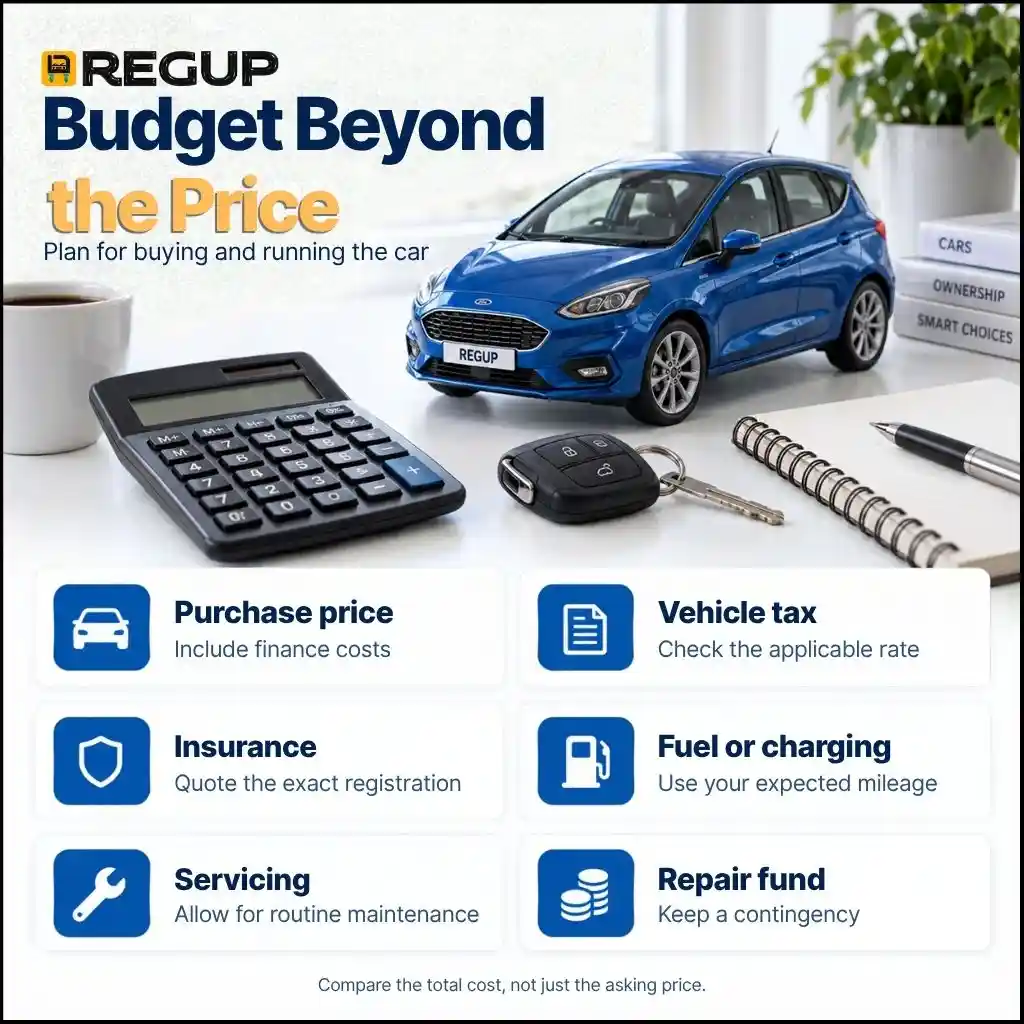
- Check the record before you check the car. A registration lookup costs you minutes and filters out most problem vehicles.
- Outstanding finance, write-off markers, stolen records and mileage gaps are the four findings that should stop a purchase outright.
- Your eyes and a data report answer different questions. Neither one replaces the other.
- Price is negotiable. Provenance is not.
- Who you buy from changes your legal position more than what you buy.
Buying a used car is a filtering job, not a shopping trip
Most guides start with the forecourt. That is the wrong end of the process. By the time you are standing next to a car with a seller talking, you have already spent your travel time and some of your objectivity.
The buyers who get this right treat it as filtering. They start with a wide list of candidates and remove vehicles using cheap, fast evidence first, leaving only two or three cars worth a physical viewing.
Registration data is the cheapest filter available. Every UK vehicle carries a public MOT and tax record, and a licensed layer of finance, theft and write-off data sits behind that. Running a registration lookup before you commit a Saturday to a 90 mile round trip is the single highest value habit in used car buying.
The second thing to accept early is that no single source answers everything. A report tells you the vehicle's recorded history. A viewing tells you its present condition. A mechanic tells you what it will cost next year. You need all three, in that order, because each one is more expensive than the last.
Set a budget that includes the year you own the car, not just the day you buy it
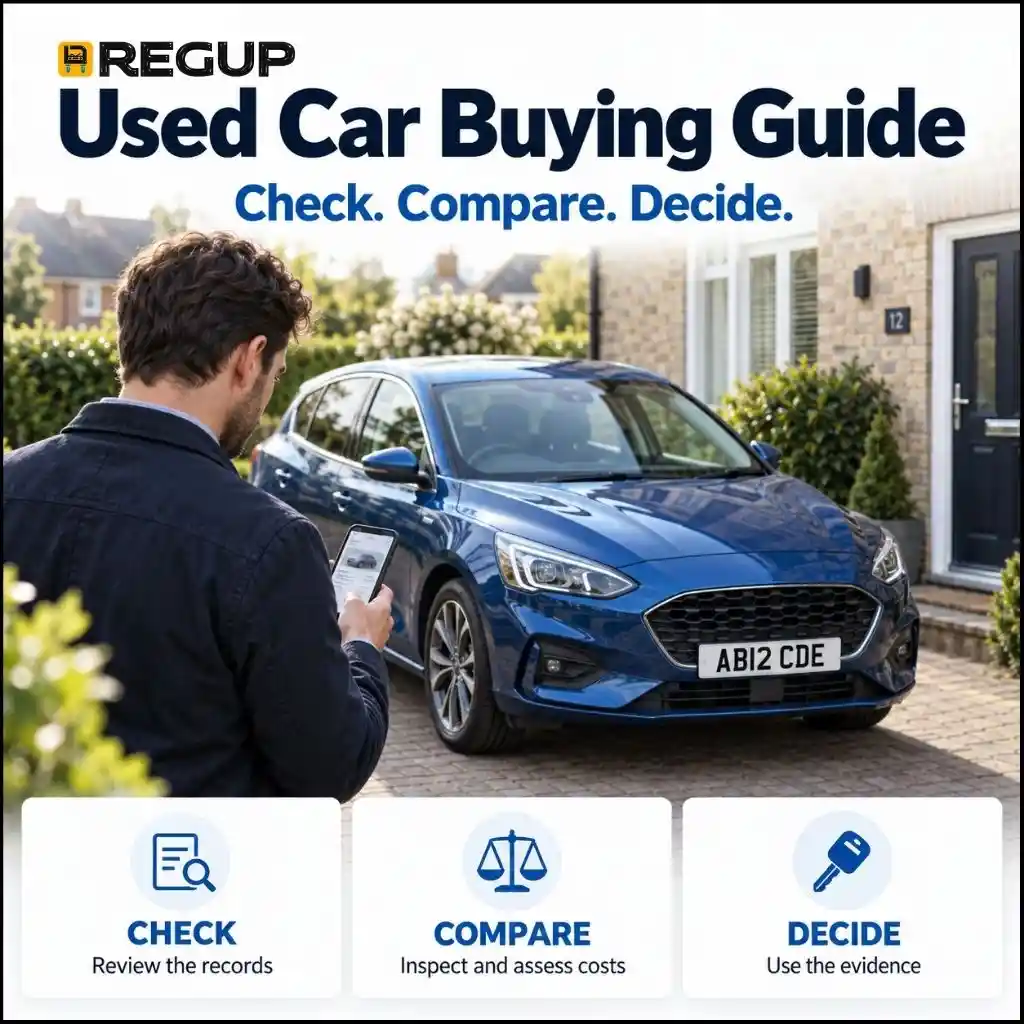
The purchase price is the number buyers fixate on, and it is rarely the number that hurts. A car that costs £1,000 less to buy and £600 more a year to run is a worse deal within 24 months.
Build your budget from five figures. The purchase price, the annual vehicle tax band, the insurance group, realistic fuel or charging costs at your actual mileage, and a servicing allowance. On a used car over eight years old, set aside a repair fund as well, because something will need doing.
Vehicle tax and specification are both checkable before you enquire. A road tax check confirms the current tax status and band, and a car specification check gives you engine size, fuel type, CO2 output and other details that feed straight into your insurance quote and running cost estimate.
Insurance is the figure buyers underestimate most often. Get a real quote on the exact registration before you agree anything, not a quote on the model name. Two cars with the same badge can sit several insurance groups apart depending on engine, trim and factory options.
If you are financing the purchase, work out the total amount payable rather than the monthly figure. The monthly payment is designed to feel affordable. The total is what you actually pay. The free guidance from MoneyHelper on car finance is a sensible neutral reference if you are comparing hire purchase against a personal loan.
Shortlist by registration, not by photographs
Photographs are marketing. A registration is a fact. Once you have three to six candidate vehicles, collect the registration for each one and check them as a batch before you contact any seller.
Start free and go deeper only on the cars that survive. A free car check returns the public record layer: MOT history, tax status and basic specification. That alone removes a surprising number of adverts, usually because the MOT record does not match the advert's claims about mileage or service history.
Look for the pattern, not just the pass or fail. An MOT record with regular annual tests, gradually accumulating advisories and consistent mileage tells you a car has been used and maintained normally. A record with a two year gap, a sudden mileage drop or a cluster of corrosion advisories tells you something else.
Where the advert says "full service history" and the MOT record shows a missing year, you have a question to ask before you drive anywhere. A recent failure is not automatically a problem either, and our MOT failure and expiry guide explains how to read one. Sellers who answer that question clearly are usually fine. Sellers who get defensive are telling you something.
The four findings that should end a purchase
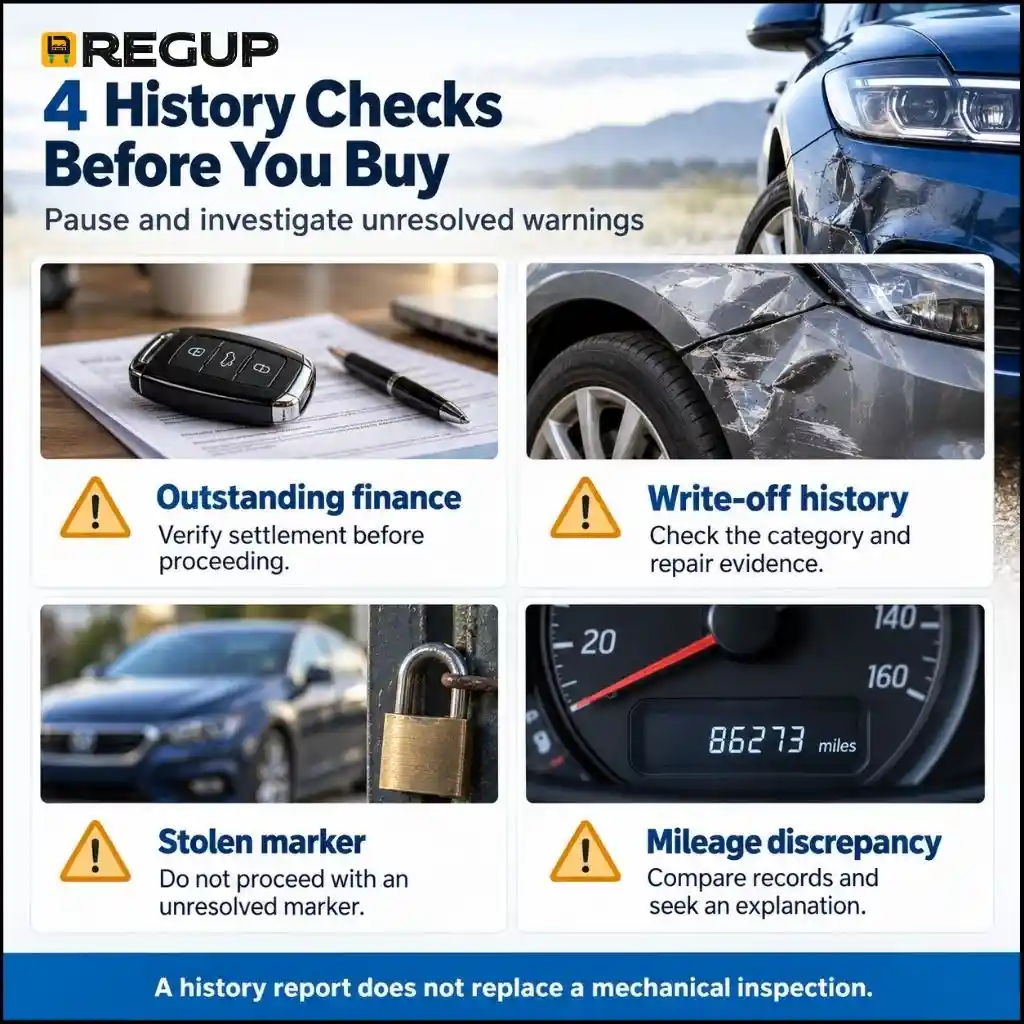
Not every negative finding is a dealbreaker. Four of them are, and all four sit in the licensed data layer rather than the public record.
Outstanding finance
If money is still owed against the vehicle, the finance company retains an interest in it. Buying it privately can mean losing both the car and your money, because the debt follows the vehicle rather than the seller. A car finance check is the check most private buyers skip and the one that causes the largest single losses. Our own blog on checking outstanding finance before buying walks through what to do if a marker appears.
Write-off markers
An insurance write-off is not automatically unsafe or unsellable, but it must be disclosed and it must be priced in. Category S and Category N vehicles can be repaired and returned to the road legally. Category A and B cannot. If you are weighing up a repaired write-off, read our breakdown of Cat S versus Cat N first, then run a write-off check to confirm what is actually recorded.
Stolen markers
A vehicle recorded as stolen on the Police National Computer can be seized from you, and you will not be compensated. There is no negotiation here and no discount that makes it worthwhile. A stolen car check takes seconds, and our guide on how to check if a car is stolen covers the warning signs that usually accompany one.
Mileage inconsistencies
Clocking is still one of the most common used car frauds in the UK, and it is easy to spot in the data because MOT readings create a timeline. A reading that falls, or a jump that does not fit the pattern, needs explaining.
Run a mileage check and compare it against our guidance on reading MOT mileage history.
Everything else is a negotiation point. These four are exits.
Read the advert the way an underwriter would
Adverts are written to attract enquiries, so read them for what is missing rather than what is promised.
A genuine private advert usually shows the registration plate, several photographs taken in one location on one day, a specific mileage figure, and a reason for selling. It gives a location and a phone number that connects to a person who knows the car.
Treat these as prompts to slow down: a price notably below similar cars, photographs that look like a manufacturer brochure or appear on other listings, a seller who will only communicate by message, a plate that is blurred or removed, or any suggestion that the car is in storage, abroad, or with a shipping company.
If the plate is hidden, ask for it. A seller with nothing to hide will send it. If they refuse, you have saved yourself a journey. For vehicles advertised entirely online, our guide to buying a car online covers the remote verification steps in more detail.
Cross-reference the asking price against a car valuation check so you know whether you are looking at a fair price, an optimistic one, or bait.
What to inspect in person, and what the paperwork should confirm
Arrive in daylight, on a dry day, at the seller's home address rather than a car park or service station. That address matters legally if anything goes wrong later, and a private seller who will not meet at home is a private seller you should walk away from.
Work through the car in a fixed order so you do not get distracted by the parts that look good. Body panels and gaps first, checking that paint finish and panel alignment are consistent all the way round. Then tyres, including the spare, looking at tread depth and whether wear is even across the width. Then glass, lights and wipers. Then the interior, where wear on the steering wheel, pedals and driver's seat bolster should broadly match the claimed mileage.
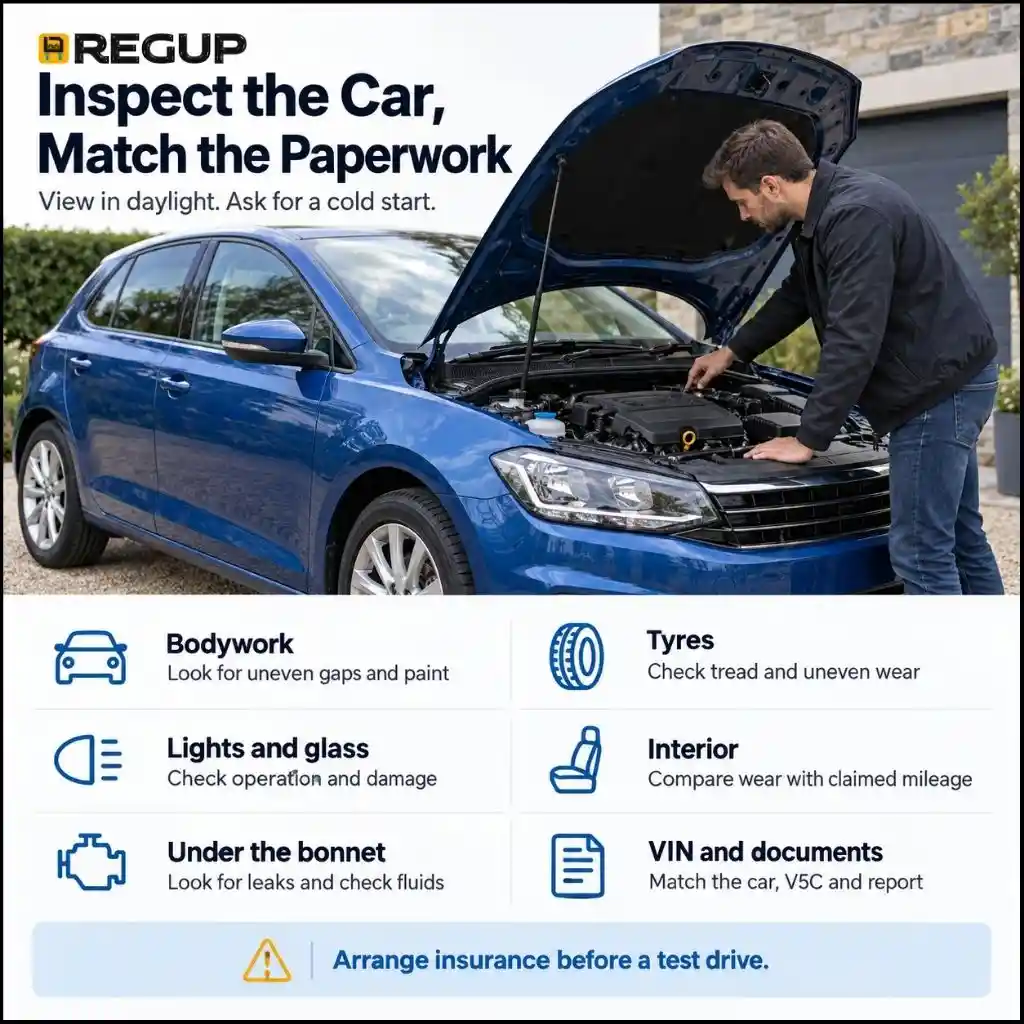
Open the bonnet cold. A car that is already warm when you arrive may have been run to hide a cold start problem. Check the oil, the coolant level and colour, and look for fresh fluid trails or recently cleaned areas that seem out of place.
Then match the metal to the paperwork. The VIN stamped on the vehicle should match the VIN on the V5C and on your report. If you are not sure where to look, our guide on where to find the VIN number on a car shows the usual locations, and a VIN check confirms the recorded details against it.
A mismatch between the plate, the VIN and the V5C is the signature of a cloned vehicle. It is rare, it is serious, and it is the reason this step exists.
Treat the test drive as a diagnostic
Fifteen minutes is the minimum, and it needs to include more than a loop of the seller's estate. You want a rough surface to hear the suspension, a stretch at 50mph or more to feel for vibration and pulling, a hill for the clutch and gearbox, and a slow manoeuvre to hear the steering at full lock.
Drive with the radio off and the windows up for part of it, then with the windows down for another part. Different faults announce themselves in different conditions.
Before any of that, sort your insurance. Driving a car you do not own without cover is an offence regardless of the seller's assurances, and a "driving other cars" extension on a comprehensive policy is not universal and is usually third party only. Our test drive guide sets out the cover options and a route plan you can follow.
Negotiate on evidence, not on opinion
Once you have a report, a viewing and a drive, you are negotiating from a much stronger position than the seller expects, because you are negotiating with specifics.
"It needs two tyres and the rear brake advisory from the last MOT has not been addressed" is a number. "It seems a bit expensive" is an opinion, and opinions get met with silence.
Write down every chargeable finding before you talk price: advisories from the MOT record, tyres below 3mm, a missing service stamp, a cambelt due by age rather than mileage, a second key that does not exist. A missing second key alone can be a few hundred pounds on a modern car.
Then decide your walk away figure before the conversation starts, and be willing to use it. There is always another car. The scarcity you feel at the roadside is almost never real.
Who you buy from changes your legal position
This is the part buyers discover too late. The car is the same car. Your rights are not the same rights.
Buy from a dealer and the Consumer Rights Act 2015 applies, which gives you a short term right to reject a faulty vehicle and a repair route after that. Buy privately and that Act does not apply at all. The private seller's obligations are narrow: the car must be theirs to sell and it must match how they described it.
Buy online from a dealer without seeing the car first and a separate set of distance selling rules can give you a cancellation window that an in person purchase does not. Buy at auction and you are usually accepting the lot as it stands.
Before you choose where to buy, read our guide to used car consumer rights so the trade off is a decision rather than a surprise. The consumer guidance published by Citizens Advice is a useful second reference.
Handover, paperwork and the first week
The exchange itself should be unremarkable if everything before it was done properly.
Confirm the V5C is the original document and that the registered keeper's name and address match the person and the place you are standing in. Complete the change of keeper, take the green new keeper slip, and make sure the seller notifies DVLA. Get a written receipt signed by both parties, including the registration, VIN, mileage, price, date and both addresses.
Tax the vehicle before you drive it away. Vehicle tax does not transfer with a sale, so the moment the seller notifies DVLA, the car is untaxed until you tax it. Your insurance must also be live before you move.
Our car sale documents guide sets out every document for both sides of the transaction and what each one actually proves.
In the first week, read the service history properly rather than glancing at the stamps, check the tyres and fluid levels yourself, and note anything that feels different from the test drive. If you bought from a dealer, that first fortnight is when your strongest legal remedy exists.
The used car buying checklist
Set a total annual cost budget including tax, insurance, fuel and servicing.
Shortlist three to six vehicles and collect every registration.
Run a free check on each to review MOT history, tax status and specification.
Run a paid report on the survivors for finance, write-off, stolen and mileage data.
Compare the asking price against a valuation.
Ask the seller the questions the data raised before you travel.
View in daylight, at the seller's address, with the engine cold.
Match the VIN on the car to the V5C and to your report.
Arrange insurance, then test drive for at least 20 minutes on varied roads.
Consider an independent mechanical inspection on anything expensive or unfamiliar.
Negotiate against a written list of chargeable findings.
Complete the V5C, take the new keeper slip, get a signed receipt, then tax and insure before driving.
You can see the format of the data before you buy anything by viewing a sample REGUP vehicle report, or run the full set in one place with a pre-purchase used car check.
Frequently asked questions
What should I check first when buying a used car in the UK?
Check the registration before anything else. A free lookup returns MOT history, tax status and specification, which is enough to tell you whether the advert is accurate and whether the car is worth travelling to see. Physical inspection comes after the record check, not before it.
Is a paid vehicle history report worth it on a cheap car?
Yes, and arguably more so. Outstanding finance, stolen markers and write-off records appear on inexpensive cars as often as expensive ones, and the loss on a £2,000 car bought with finance attached is still £2,000. The report cost is a small fraction of the purchase either way.
How many miles a year is normal for a used car?
Around 7,000 to 8,000 miles a year is the common UK average for private cars, so a ten year old car with roughly 80,000 miles sits in the normal range. Much lower can mean short journeys and limited use, which brings its own wear. What matters more than the total is whether the MOT readings increase consistently.
Can I get my money back if a used car turns out to be faulty?
It depends entirely on who sold it. From a dealer you normally have a 30 day short term right to reject under the Consumer Rights Act 2015. From a private seller you generally have no right to reject unless the car was misdescribed or was not theirs to sell.
Does a vehicle history check replace a mechanical inspection?
No. A history check reports what is recorded about the vehicle: finance, theft, write-offs, mileage, MOT and tax. It cannot assess clutch wear, suspension condition or engine health. The two checks answer different questions and serious buyers use both.
Should I buy a car with an outstanding MOT advisory?
Advisories are not failures, and most cars over five years old carry a few. Treat them as a costed negotiation point rather than a reason to walk away. A corrosion advisory on a structural area is the exception, because that tends to get worse and more expensive.