Key points
- Only a DVLA registered supplier can make a road number plate
- Plates supplied from 1 September 2021 must meet BS AU 145e
- White reflective front plate, yellow reflective rear plate, no background pattern
- Characters must be a single shade of black in the Charles Wright 2001 font
- 3D and 4D plates are legal; two tone, tinted and ghost plates are not
- Flags need an approved identifier; only zero emission vehicles may have a green flash
- Motorbikes first registered from 1 September 2001 need a rear plate only
- An illegal plate can mean a fine of up to £1,000 and an MOT failure
UK Number Plate Rules and the Law
UK number plate rules decide what your plate must show, how it is made and who can make it. These UK number plates regulations apply to every car, van, motorbike and trailer on a public road. Get them wrong and you face a fine of up to £1,000 and an MOT failure. This guide sets out the law as it stands, checked against GOV.UK and the British Standard, in the order a plate is made: supplier, standard, colours, characters, extras and display. Every road plate made in our number plate builder follows these rules automatically.
The Rules at a Glance
Only a DVLA registered number plate supplier can make a road plate, after seeing proof of identity and entitlement
Plates supplied from 1 September 2021 must meet BS AU 145e and carry that mark
Black characters on a reflective white front plate and yellow rear plate, with no background pattern
Characters in a single shade of black, in the prescribed font, at a fixed size and spacing
Raised 3D and 4D characters are allowed; two tone, tinted and ghost effects are not
Only approved flags and national identifiers, or the green flash on zero emission vehicles
Cars show front and rear plates; motorbikes first registered from 1 September 2001 show a rear plate only
Who Can Make a Number Plate
You cannot legally have a road plate made by just anyone. Number plates must come from a supplier on the DVLA Register of Number Plate Suppliers. Before making a plate, the supplier must see a document proving your name and address and a document proving you are entitled to the registration, then keep a record of the sale for three years. A business that supplies plates without registering can be fined up to £5,000. Our guide to the documents you need lists every accepted document.
The British Standard: BS AU 145e
Every plate supplied on or after 1 September 2021 must meet BS AU 145e and show that mark. The British Number Plate Manufacturers Association summarises how the standard tightened the rules in three ways:
Characters must be a single shade of black, which ended two tone and shaded 3D effect fonts
Plates must pass tougher durability tests, including abrasion and adhesion
Characters must contrast clearly under near infrared light so ANPR cameras can read them
Plates fitted before 1 September 2021 to the older BS AU 145d standard stay legal. You only need BS AU 145e plates when you next replace them, and one old and one new plate can be fitted together.
Vehicle Number Plate Colours and Materials
Under the display rules, a plate must be made from reflective material, show black characters on a white background at the front and a yellow background at the rear, and carry no background pattern. The characters themselves must not be reflective and must not be removable.
Black and silver plates
Black plates with silver or white characters are only allowed on vehicles built before 1 January 1980 that are in the historic vehicle tax class. Classic owners can order these as metal and pressed number plates.
The green flash
Zero emission vehicles may carry a green flash on the plate. Petrol, diesel and hybrid vehicles may not. See green flash number plates for eligibility.
Font, Character Size and Spacing
Registration characters must use the prescribed font set out in the Road Vehicles (Display of Registration Marks) Regulations 2001, known as Charles Wright 2001. On a car plate each character is 79mm tall and 50mm wide (except 1 and I), with an 11mm gap between characters and a 33mm gap between the two groups. Motorcycles may use smaller 64mm characters, covered on our motorbike number plates page.
GOV.UK is clear that you cannot rearrange or alter the letters and numbers to make them read differently. Closing a gap, moving a group or placing a screw so it changes a character's shape all count as altering the registration. The detail is in our guides to number plate spacing rules and the UK number plate font.
3D, 4D, Ghost and Tinted Plates
Raised characters are legal. 3D gel number plates and 4D number plates pass the MOT when every character is a single shade of black and the plate meets BS AU 145e. What fails is any effect that changes the shade or contrast of the characters: two tone or outlined letters, tinted or smoked covers, and ghost plates designed to be hard for cameras to read. Our guides on whether 3D and 4D plates are legal and ghost and tinted number plates show examples of each.
Flags, National Identifiers and UK Stickers
A flag can be shown on the left-hand side of the plate, and only together with identifying letters. The flag sits above the identifier, neither can be more than 50mm wide, and neither can sit on the plate margin.
Flag | Identifiers allowed |
|---|---|
Union flag | UNITED KINGDOM, United Kingdom, UK, GREAT BRITAIN, Great Britain, GB |
Cross of St George | ENGLAND, England, ENG, Eng |
Cross of St Andrew (Saltire) | SCOTLAND, Scotland, SCO, Sco |
Red Dragon of Wales | WALES, Wales, CYMRU, Cymru, CYM, Cym |
For driving abroad, a plate with the UK identifier and the Union flag means you do not need a UK sticker, except in Spain, Cyprus and Malta. A plate with GB, a national flag of England, Scotland or Wales, or no flag at all still needs a UK sticker, according to GOV.UK guidance on driving in the EU. Our guide to flags and national identifiers covers every combination.
Where Number Plates Must Be Displayed
Cars and vans: a white plate on the front and a yellow plate on the rear, both fixed securely and clearly visible
Motorcycles and motor tricycles first registered from 1 September 2001: a rear plate only, with the characters on two lines. Older bikes may also carry a front plate
Trailers: the same registration as the towing vehicle, on the rearmost trailer if towing more than one. Registered trailers travelling abroad also display their own trailer registration plate, covered under trailer number plates
The rear plate must be lit by the number plate lamp when lights are required
Private Registrations Follow the Same Rules
A private registration gets no exemption from the display rules. You cannot use one to make a vehicle look newer than it is, and you cannot space or alter the characters to spell a name or word. Mis-spaced private plates are among the most common illegal plates on the road. Buying, assigning and displaying a mark is covered in private and personalised number plates.
What the MOT Checks on Your Plates
At every MOT the tester checks that each required plate is present, secure and in good condition, that the background is the right colour with no pattern, and that the characters are correctly formed, spaced and readable. A cracked, faded, delaminating or mis-spaced plate is a common and easily avoided failure.
Show Plates and Novelty Plates
Plates with slogans, coloured characters, novelty fonts, carbon backgrounds or rearranged letters are show plates. They can be sold and used at car shows, on private land or indoors, but never on a public road. Buy them as show plates with that understanding.
Number Plate Law Penalties: Fines and MOT Failure
Driving with incorrectly displayed number plates can lead to a fine of up to £1,000, and the vehicle will fail its MOT. Our guide to number plate fines and MOT failure explains enforcement in practice, and driving after an MOT failure covers what you can do before the retest.
How to Check Your Number Plates Are Legal
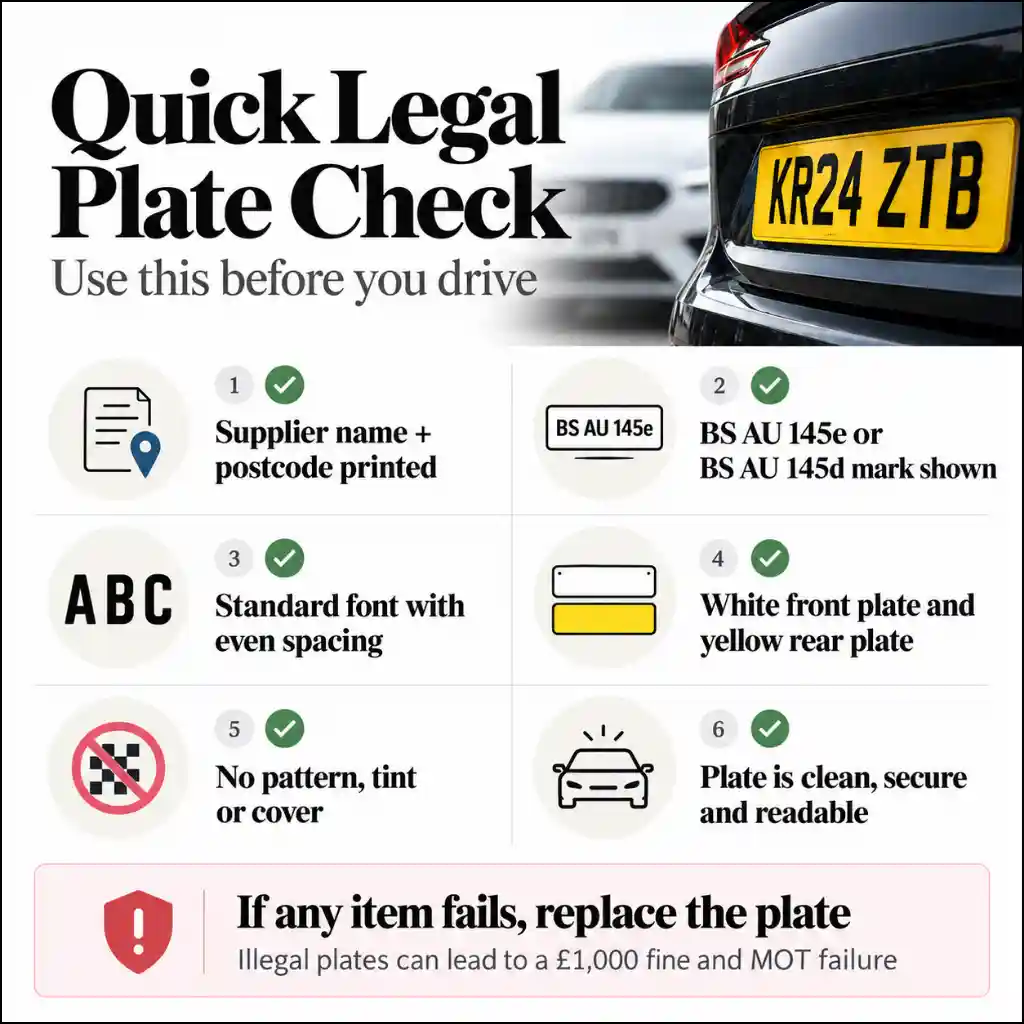
Road legal number plates pass every line of this checklist. If any line fails, the plate needs replacing:
The supplier name and postcode are printed along the bottom, with BS AU 145e (or BS AU 145d on plates fitted before September 2021)
The characters are solid black, in the standard font, with even gaps and no added marks
The front plate is white and the rear plate yellow, with no pattern, tint or cover
Any flag is an approved one with its identifier, or a green flash on a zero emission vehicle
The plate is clean, uncracked, fixed securely and readable from the front or rear of the vehicle
If your plates fail the check, order road legal plates from a registered supplier, or replace a single damaged plate through replacement number plates.
Frequently asked questions
What makes a number plate legal in the UK?
A legal number plate is made by a DVLA registered supplier, meets BS AU 145e, shows black characters in a single shade on a reflective white front or yellow rear background, uses the prescribed font and spacing, and carries the supplier name and postcode.
Do I need to replace my old plates for the new standard?
No. Plates fitted before 1 September 2021 to BS AU 145d remain legal. The BS AU 145e rules apply when plates are next supplied.
Are 3D and 4D number plates legal?
Yes, when the raised characters are a single shade of black and the plate meets BS AU 145e. Two tone, tinted and ghost versions are illegal.
Can I change the spacing on my number plate?
No. You cannot rearrange or alter the characters to make them read differently, and the gaps between characters and groups are fixed by law.
Which flags can I have on my number plate?
The Union flag, the Cross of St George, the Cross of St Andrew or the Red Dragon of Wales, each with an approved identifier such as UK, GB, ENG, SCO or CYM, no more than 50mm wide.
Do I need a UK sticker to drive abroad?
Not if your plate has the UK identifier with the Union flag, except in Spain, Cyprus and Malta. Plates with GB, a national flag of England, Scotland or Wales, or no flag need a UK sticker.
Are black and silver number plates legal?
Only on vehicles built before 1 January 1980 that are in the historic vehicle tax class.
What is the fine for an illegal number plate?
Up to £1,000, and the vehicle will fail its MOT.