Key points
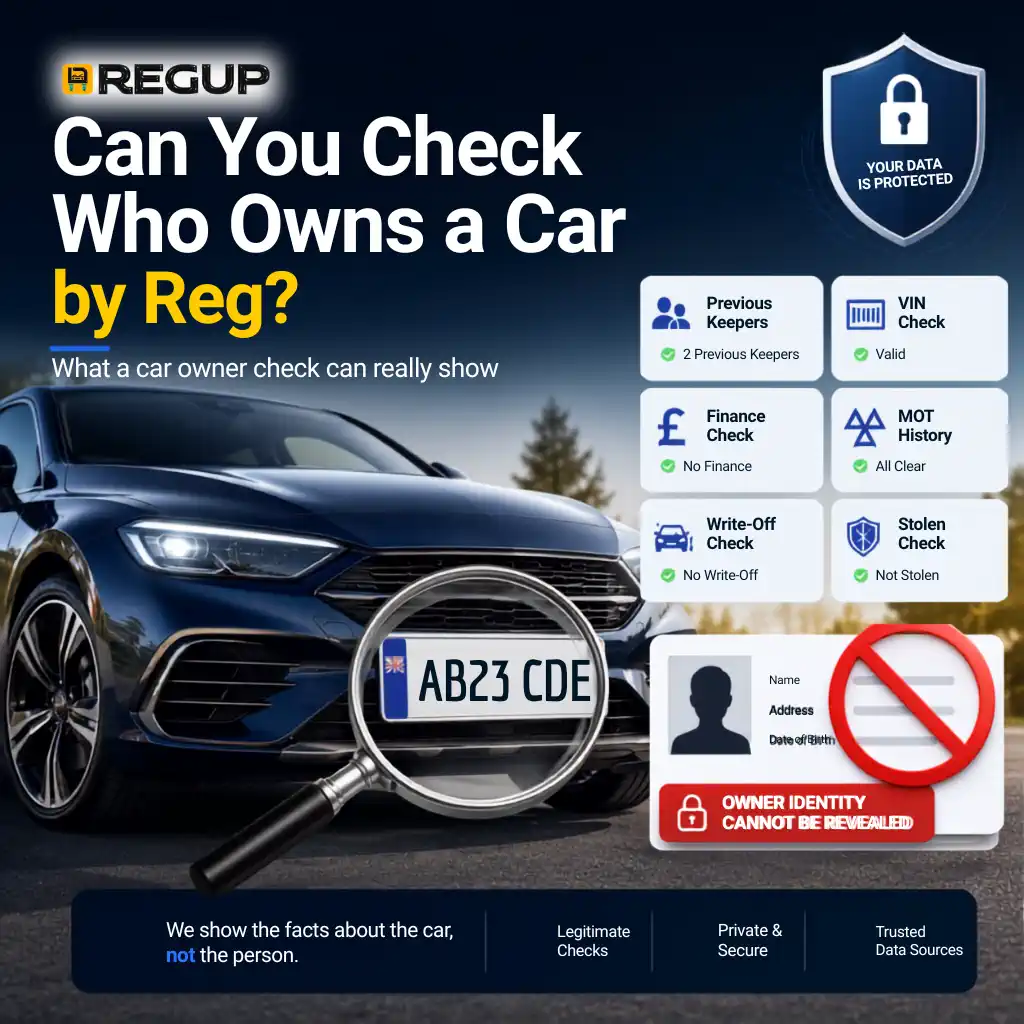
- No service can legally reveal a car owner's name and address from a number plate.
- Keeper details are personal data, protected under the Data Protection Act 2018 and UK GDPR.
- A car ownership check shows previous keeper count, last keeper change date, and first registration date.
- Form V888 is the only lawful route to DVLA keeper details, and requires reasonable cause.
- Reasonable cause includes collisions, abandoned vehicles, insurance claims and legal proceedings.
- Curiosity or wanting to contact a private seller does not count as reasonable cause.
- Buyers should match the V5C logbook to the seller, check the VIN, and run finance and stolen checks instead.
Can You Check Who Owns a Car from the Registration?
No. Not by name and address, and not from any vehicle check service, including this one.
A registered keeper's details are personal data. Releasing them is controlled by DVLA under the Data Protection Act 2018 and UK GDPR, and no commercial car owner check can hand them over. Any website promising to tell you who owns a car for a small fee is either selling you something different from what you think, or operating outside the law.
That is the short answer. The useful part is what a car vehicle owner check can legitimately tell you, and how to get keeper details properly when you have a genuine reason.
Why a Car Ownership Check Cannot Name the Owner
DVLA holds keeper records for every registered vehicle in the UK. Those records contain a name and address, which makes them personal data rather than vehicle data.
Vehicle data is different. Make, model, colour, engine, MOT history, tax status, write-off markers and mileage all describe the car, not a person. That is why anyone can look them up freely, and why a vehicle owner check or a vehicle ownership check returns those instead of a name.
So car ownership verification in the UK is not about identifying a person from a plate. It is about testing whether the person in front of you matches the paperwork.
The distinction matters more than it sounds. If ownership were searchable by plate, anyone who saw your car outside your house could find your address. The restriction exists to protect you as much as the person you are trying to trace.
What a Car Ownership Check Actually Shows You
Run a check ownership of vehicle search on any UK registration and you get the ownership picture without the identity. The same applies if you search check ownership of a car, check ownership of car or check the car ownership. All return vehicle records, never personal ones.
Number of Previous keepers
How many people have registered the vehicle. This is usually the number people actually want. Six keepers on a four year old car tells you something a name never would.
Date of the Last Keeper Change
When the vehicle last changed hands. A car sold three times in eighteen months is worth asking about. A car bought a fortnight ago and already being sold is worth asking harder.
Date of First Registration
When the vehicle entered service, which is not always the year in the advert.
Whether the Seller Matches the Record
You cannot see the keeper's name in a report, but you can see it on the V5C logbook when you view the car. Compare the two. If the person selling is not the registered keeper, ask why before anything else.
All of this sits in a full vehicle history report alongside the checks that carry real financial risk.
How to Check the Owner of a Vehicle Legitimately
There is a proper route, and it works when you have what DVLA calls reasonable cause.
The V888 request
Form V888 is how an individual applies to DVLA for keeper details. You must state your reason, and DVLA decides whether it qualifies. It is the only lawful way to check registered keeper of vehicle records in the UK.
What counts as reasonable cause
Tracing the owner after a road traffic collision
An abandoned or dangerously parked vehicle
Insurance claims and legal proceedings
Trespass on private land, where the enquirer is the landowner
Local authority and police enforcement
What does not count
Curiosity about a neighbour's car
Wanting to buy a vehicle you saw parked
Tracing someone you have lost contact with
A dispute you would rather settle privately
Applications without a valid reason are refused. That is the system working as intended.
If you are buying: what to check instead
Most people searching how to check vehicle owner or how to check owner of vehicle details are about to buy a car and want reassurance the seller is genuine. Identity is the wrong tool for that. These are the right ones.
Match the V5C to the person and the place
Ask to see the logbook. The name and address on it should match the seller and the address you are standing at. Meeting in a car park, or a seller whose name is not on the V5C, is the oldest warning sign in private sales.
Check the vehicle identity
Confirm the VIN on the car matches the VIN on the V5C and the record. A VIN check is how cloned vehicles get caught, and a cloned car is the case where ownership genuinely is being hidden.
Check for money owed on it
If there is outstanding finance, the lender still owns the car regardless of who is selling it, and they can repossess it after you have paid. An outstanding finance check answers the ownership question that actually costs people money.
Check it is not recorded stolen
A stolen car check tests the registration against recorded markers. Buy a stolen car privately and you lose both the vehicle and the payment.
Check the history the seller did not mention
Run a free car check for the MOT history and mileage, then a write-off check before you agree a price.
Common situations, and what to do
Someone hit my car and drove off
Report it to the police and get a crime reference number. If you have the registration, your insurer or the police can find owner of vehicle records through the proper channel. Do not attempt to trace the person yourself.
A vehicle has been abandoned near me
Report it to your local council. They have direct access and a statutory process for abandoned vehicles.
Someone is parked on my land
As the landowner you may apply for keeper details, usually through an accredited trade body or a V888 request with evidence of ownership of the land.
I want to buy a car I saw parked
Leave a note. There is no legal route to the keeper for this, and there should not be.
I am checking a car before I buy it
Check the keeper count, the V5C, the VIN, finance and write-off history. Those answer the real question, which is whether the car is what the seller says it is.
Final Thoughts
You cannot look up who owns a car from a number plate, and any car owner checker suggesting otherwise is trading on a question it cannot answer.
What you can do is far more useful when money is involved. Check how many keepers it has had, whether the V5C matches the seller, whether a lender still has a claim on it, and what the history says. Start with a free car check and take a full vehicle history report before you pay a deposit.
Frequently asked questions
Can I find out who owns a car by the number plate?
Not by name. UK data protection law prevents any check service from releasing keeper details. You can see how many keepers a vehicle has had and when ownership last changed.
How do I check the owner of a car?
You cannot check owner of car details by name. What you can do is compare the V5C logbook against the seller in person, and run a check vehicle ownership search for keeper count and dates.
Is there a free car owner check?
You can check vehicle owner history free in the sense of keeper counts and dates, but no free or paid service can lawfully give you a name and address without DVLA approval.
How do I check car ownership before buying?
Compare the V5C logbook against the seller's own identification, confirm the VIN matches, and run a finance check to make sure no lender has a claim on the vehicle.
Can I check the registered keeper of a vehicle?
Only through DVLA, using form V888, and only if you have reasonable cause such as a collision, an abandoned vehicle or a legal claim.
Do websites that promise owner details actually work?
They return vehicle data, not owner identity. Any that claim otherwise are misdescribing what they sell. Judge a check service by what it discloses about finance, write-offs and mileage, not by what it hints at.
Does the number of previous keepers matter?
Yes. A high keeper count on a young car suggests people did not keep it long, which is worth a question. It is not proof of a problem, but it is a reason to look harder at the service history and MOT record.
Can I see who owned a car before me?
You can see how many previous keepers there were, not who they were. If you need to contact a previous keeper about service history, the current V5C does not list them either.